Showing posts with label DNA. Show all posts

2012-08-17

DNA Data Storage: The Ultimate Hard Drive

Book written in DNA code | Science | The Guardian

Scientists who encoded the book say it could soon be cheaper to store information in DNA than in conventional digital devices


Scientists have for the first time used DNA to encode the contents of a book. At 53,000 words, and including 11 images and a computer program, it is the largest amount of data yet stored artificially using the genetic material.

[...]

A three-strong team led by Professor George Church of Harvard Medical School has now demonstrated that the technology to store data in DNA, while still slow, is becoming more practical. They report in the journal Science that the 5.27 megabit collection of data they stored is more than 600 times bigger than the largest dataset previously encoded this way.

DNA: The Ultimate Hard Drive - ScienceNOW

To demonstrate its system in action, the team used the DNA chips to encode a genetics book co-authored by Church. It worked. After converting the book into DNA and translating it back into digital form, the team’s system had a raw error rate of only two errors per million bits, amounting to a few single-letter typos. That is on par with DVDs and far better than magnetic hard drives. And because of their tiny size, DNA chips are now the storage medium with the highest known information density, the researchers report online today in Science.

Don’t replace your flash drive with genetic material just yet, however. The cost of the DNA sequencer and other instruments "currently makes this impractical for general use," says Daniel Gibson, a synthetic biologist at the J. Craig Venter Institute in Rockville, Maryland, "but the field is moving fast and the technology will soon be cheaper, faster, and smaller." [...]

Writing the Book in DNA : Wyss Institute at Harvard

The researchers used binary code to preserve the text, images and formatting of the book. While the scale is roughly what a 5 1/4-inch floppy disk once held, the density of the bits is nearly off the charts: 5.5 petabits, or 1 million gigabits, per cubic millimeter. "The information density and scale compare favorably with other experimental storage methods from biology and physics," said Sriram Kosuri, a senior scientist at the Wyss Institute and senior author on the paper. The team also included Yuan Gao, a former Wyss postdoc who is now an associate professor of biomedical engineering at Johns Hopkins University.


Book converted to DNA then 'read' to show off bio-digital storage - Future of Tech on NBCNews.com

Drawbacks to a DNA hard driveDNA data storage still has a long way to go before it makes an appearance in the local Best Buy, however. Storing even a small amount of data is still costly. Kosuri and his colleagues' book cost them thousands of dollars to synthesize and sequence, Kosuri said, and it was less than a megabyte in size. Larger works would probably cost proportionately more to make, Lonardi said. Meanwhile, a $10 flash drive can store 16 gigabytes of data.

Kosuri's method is not rewriteable, so once some data has been stored, it can't be altered.


2011-10-17

Self-Replicating Nanoscale Patterns Promising for Fabrication of New Materials

Scientists Build Self-Replicating Molecule : Discovery News

New York University researchers led by Paul Chaikin have found a way to use synthetic DNA to make molecules that reproduce themselves. The technique gives scientists a tool to create different combinations on the DNA that aren't necessarily available in nature. That opens up billions of possibilities for building completely new materials and even molecular machines. Chaikin and his colleaques reported their results in this week's journal Nature.


NYU scientists have developed artificial structures that can self-replicate, a process that has the potential to yield new types of materials. These structures consist of triple helix molecules containing three DNA double helices. Image courtesy of Nature.

“This is the first step in the process of creating artificial self-replicating materials of an arbitrary composition,” said Paul Chaikin, a professor in NYU’s Department of Physics and one of the study’s co-authors. “The next challenge is to create a process in which self-replication occurs not only for a few generations, but long enough to show exponential growth.”

“While our replication method requires multiple chemical and thermal processing cycles, we have demonstrated that it is possible to replicate not just molecules like cellular DNA or RNA, but discrete structures that could in principle assume many different shapes, have many different functional features, and be associated with many different types of chemical species,” added Nadrian Seeman, a professor in NYU’s Department of Chemistry and a co-author of the study.


DNA tiles
The researchers used artificial structures of DNA - so-called DNA tiles - dissolved in water to demonstrate the new process. These tiles are several tens of nanometres in size and consist of compactly folded  DNA strands, from which four loose ends with a specific sequence of the bases A, C, G and T protrude. Like a barcode, these sticky ends determine the identity of a tile and ensure that tiles with complementary ends attach to each other: A always adheres to T, and C to G. When joined, the ends of the two tiles together form the characteristic double helix structure.

Sticking
The researchers arranged seven tiles with two different identities (for example indicated with the letters X and Y) to form the ‘word’ X-Y-Y-X-Y-X-Y. Subsequently, tiles with complementary sticky ends, X' and Y', spontaneously attached themselves in the right order to this initial structure (X'-Y'-Y'-X'-Y'-X'-Y'). The sticky ends only stick at a lower temperature and so the 'daughter word' was separated from the initial structure by briefly increasing the temperature. After this the researchers repeated the process with the remaining separate tiles until these formed 'granddaughters' with exactly the same XY sequence of letters

2010-06-24

Self-assembling Biological Nanodevices Based Upon Tensegrity

HMS website banner

Researchers create self-assembling nanodevices that move and change shape on demand

BOSTON, Mass. (June 21, 2010) —By emulating nature’s design principles, a team at Harvard’s Wyss Institute for Biologically Inspired Engineering, Harvard Medical School and Dana-Farber Cancer Institute has created nanodevices made of DNA that self-assemble and can be programmed to move and change shape on demand. In contrast to existing nanotechnologies, these programmable nanodevices are highly suitable for medical applications because DNA is both biocompatible and biodegradable.

Built at the scale of one billionth of a meter, each device is made of a circular, single-stranded DNA molecule that, once it has been mixed together with many short pieces of complementary DNA, self-assembles into a predetermined 3D structure. Double helices fold up into larger, rigid linear struts that connect by intervening single-stranded DNA. These single strands of DNA pull the struts up into a 3D form—much like tethers pull tent poles up to form a tent. The structure’s strength and stability result from the way it distributes and balances the counteracting forces of tension and compression.

This architectural principle—known as tensegrity—has been the focus of artists and architects for many years, but it also exists throughout nature. In the human body, for example, bones serve as compression struts, with muscles, tendons and ligaments acting as tension bearers that enable us to stand up against gravity. The same principle governs how cells control their shape at the microscale.

An electron micrograph of an actual nanoscale tensegrity built using the new DNA-based, self-assembling nanofabrication capabilities. Scale bars equal 20 nanometers (billionths of a meter). Images by Tim Liedl

Nature Nanotechnology
Published online: 20 June 2010 | doi:10.1038/nnano.2010.107

Self-assembly of three-dimensional prestressed tensegrity structures from DNA

Tim Liedl Björn, Högberg, Jessica Tytell, Donald E. Ingber & William M. Shih


Tensegrity


Tensegrity structures are structures based on the combination of a few simple but subtle and deep design patterns:
  • loading members only in pure compression or pure tension, meaning the structure will only fail if the cables yield or the rods buckle
  • preload or tensional prestress, which allows cables to be rigid in tension
  • mechanical stability, which allows the members to remain in tension/compression as stress on the structure increases
Because of these patterns, no structural member experiences a bending moment. This produces exceptionally rigid structures for their mass and for the cross section of the components.


Welcome to the Shih Lab. We explore design principles for self-assembling molecular machines, primarily using structural DNA nanotechnology to build our model systems. We seek to apply our knowledge towards construction of artificial systems that help solve problems of biological and medical interest.
[...]

Collected from: Home

William Shih

Shih is an Associate Professor in the Department of Biological Chemistry and Molecular Pharmacology at Harvard Medical School, and Department of Cancer Biology at the Dana-Farber Cancer Institute.
[...]


Sources
HMS Press Release - Researchers create self-assembling nanodevices that move and change shape on demand
http://hms.harvard.edu/public/news/2010/062110_ingber.html
Self-assembly of three-dimensional prestressed tensegrity structures from DNA : Abstract : Nature Nanotechnology
http://www.nature.com/nnano/journal/vaop/ncurrent/abs/nnano.2010.107.html
Tensegrity - Wikipedia, the free encyclopedia
http://en.wikipedia.org/wiki/Tensegrity
YouTube - Step by Step Tensegrities (the real thing)
http://www.youtube.com/watch?v=HPLcci1uoEI
Home : Wyss Institute at Harvard
http://wyss.harvard.edu/
Home
http://research4.dfci.harvard.edu/shih/SHIH_LAB/Home.html
William Shih : Wyss Institute at Harvard
http://wyss.harvard.edu/viewpage/127/william-shih

Related
Researchers create self-assembling nanodevices that move and change shape on demand
http://www.eurekalert.org/pub_releases/2010-06/hms-rcs062110.php
Researchers create self-assembling nanodevices that move and change shape on demand
http://www.physorg.com/news196427602.html
Researchers create self-assembling nanodevices that move and change shape on demand
http://www.sciencedaily.com/releases/2010/06/100622091740.htm
DailyTech - Harvard Debuts Self-assembling Biological Nanodevices
http://www.dailytech.com/article.aspx?newsid=18818
Creation Of Self-Assembling Nanodevices That Move And Change Shape On Demand
http://www.medicalnewstoday.com/articles/192640.php

2010-03-22

Loading and Selective Release of Cargo in DNA Nanotubes


DNA Nanotechnology Breakthrough Offers Promising Applications in Medicine


ScienceDaily (Mar. 17, 2010) — A team of McGill Chemistry Department researchers led by Dr. Hanadi Sleiman has achieved a major breakthrough in the development of nanotubes -- tiny "magic bullets" that could one day deliver drugs to specific diseased cells. Sleiman explains that the research involves taking DNA out of its biological context. So rather than being used as the genetic code for life, it becomes a kind of building block for tiny nanometre-scale objects.


DNA nanotubes

DNA nanotubes can carry and release cargo on demand


DNA nanotechnology

DNA nanotechnology is a branch of nanotechnology which uses the unique molecular recognition properties of DNA and other nucleic acids to create designed, controllable structures out of DNA. This has possible applications in molecular self-assembly and in DNA computing. In this field, DNA is used as a structural material rather than as a carrier of genetic information, making it an example of bionanotechnology.


Clipped from: Hanadi Sleiman


Welcome to the Sleiman Research Group


Click here to read about our research 
(link 1, link 2, link 3 )


Our research group focuses on developing the supramolecular chemistry of DNA, to address problems in both biology and nanoscience. We use this approach to design new materials for drug delivery, diagnostic tools, antitumor therapeutics, and higher-order DNA structures for the fine organization of materials on the nanometer scale.


All aboard the DNA nanotube

Sleiman's nanotubes comprise triangular DNA 'rungs' in which the corner units are rigid organic molecules.   These triangles are connected vertically using DNA strands, thus creating a nanotube structure with evenly spaced, alternating triangular 3D capsules of two different sizes (approximately 7nm and 14nm along one edge).
When the team assembled double stranded nanotubes in the presence of different sized gold nanoparticles, the particles became trapped inside their respective sized capsules like peas in a pod. 'In effect the nanotubes act like sieves, and select the correct sizes to encapsulate,' says Sleiman.

To release the cargo, the team added specific strands of DNA that are complementary to the DNA strands that close-in the particles. This causes the nanotubes to become single stranded, thus opening up the capsules and allowing the gold nanoparticles to escape.

Sources:
  1. DNA nanotechnology breakthrough offers promising applications in medicine
  2. YouTube - DNA nanotubes
  3. DNA nanotechnology - Wikipedia, the free encyclopedia
  4. Hanadi Sleiman
  5. All aboard the DNA nanotube
Related:
  1. Loading and selective release of cargo in DNA nanotubes with longitudinal variation : Abstract : Nature Chemistry
  2. Teaching an old DNA new tricks
  3. News: DNA nanotechnology breakthrough offers promising applications in medicine
  4. DNA nanotechnology breakthrough offers promising applications in medicine
  5. Breakthrough in DNA Nanotube Research

2009-10-06

Personalized Genetic Analysis with IBM DNA Transistor

clipped from www.youtube.com

IBM DNA Transistor

A team of IBM Researchers is exploring new and innovative ways to quickly read human DNA at a low cost -- an advancement that can lead to important breakthroughs in health condition diagnosis and treatment.
clipped from www-03.ibm.com

IBM Research Aims to Build Nanoscale DNA Sequencer to Help Drive Down Cost of Personalized Genetic Analysis


IBM scientists advance genome sequencing project

This advanced research effort to demonstrate a silicon-based “DNA Transistor” could help pave the way to read human DNA easily and quickly, generating advancements in health condition diagnosis and treatment. The challenge in the effort is to slow and control the motion of the DNA through the hole so the reader can accurately decode what is in the DNA.
clipped from www-03.ibm.com
Schematics of the DNA transistor operation for the control of the translocation of a DNA through a nanopore
http://i.zdnet.com/blogs/ibmdna1.jpg
clipped from www-03.ibm.com
A cross section of IBM's DNA Transistor
http://i.zdnet.com/blogs/ibmdna2.jpg
clipped from www.youtube.com

blog it

Sources:
  1. YouTube - IBM DNA Transistor
  2. IBM Press room - 2009-10-06 IBM Research Aims to Build Nanoscale DNA Sequencer to Help Drive Down Cost of Personalized Genetic Analysis - United States
  3. YouTube - IBM DNA Transistor
Related:
  1. Can IBM's DNA transistor someday take genetic sequencing mainstream? | Between the Lines | ZDNet.com
  2. BBC NEWS | Science & Environment | DNA sequencing in a holey new way
  3. IBM Builds 'Bar Code Reader' for DNA - Inventions | Patents | New Inventions | Innovation - FOXNews.com
  4. DNA Analyzer on a Chip Promises Personalized Genetic Analysis | Gadget Lab | Wired.com
  5. IBM Research

2009-09-08

Forensic Molecular Photofitting

clipped from www.redorbit.com
redOrbit

DNA Aids Forensic Experts

US scientists report that the smallest amount of DNA found at a crime scene could help reveal the face of the criminal.

The new process called ‘forensic molecular photofitting' goes far beyond doing an identity-proving genetic fingerprint.

clipped from www.irishtimes.com
irishtimes.com

DNA sample may be enough to build an image of your face

FORENSIC SCIENCE is about to take a startling new turn – reconstructing facial features and skin tone simply by reading your DNA. This goes far beyond doing an identity-proving genetic fingerprint, it means the person’s actual face will emerge after analysing a collection of genes, according to a scientist from Pennsylvania State University.

clipped from www.dailymail.co.uk
Mail Online

The process has already been used to help identify and convict serial killer Derek Todd Lee who murdered seven women in Louisiana.

Witness statements said the offender was white but genetic testing of DNA at the crime scenes showed he was African American - which helped lead to his arrest.

He was convicted in 2004.

Analysis of DNA left at several crime scenes helped identify serial killer Derek Todd Lee

blog it


clipped from online.wsj.com

Mark Shriver, an anthropologist and geneticist at Pennsylvania State University, has also set himself a daunting challenge: Trying to construct a "picture" of a person's face by analyzing DNA. He calls the technique "forensic molecular photo fitting," and it is supported by a $500,000 grant from the U.S. Department of Justice.

His team collected DNA samples and photographs from 243 people, including many from the Penn State campus, and used computer techniques to correlate the genes with his subjects' facial features. They have found six genes that seem to influence such traits. One gene is associated with the height of the face; another is associated with its width. Yet another gene affects the shape of the lips and the nose. By piecing together these elements, Prof. Shriver hopes to create a modern-day version of the police artist sketch.

[To Sketch a Thief: Genes Draw Likeness of Suspects]
clipped from www.anthro.psu.edu
Penn State University

Anthropological Genomics Lab

Welcome to the Shriver Laboratory!

clipped from www.anthro.psu.edu
Faculty Image

blog it

Sources:
  1. DNA Aids Forensic Experts - Science News - redOrbit
  2. DNA sample may be enough to build an image of your face - The Irish Times - Mon, Feb 16, 2009
  3. DNA left at crime scene could be used to create picture of criminal's FACE, say scientists | Mail Online
  4. Genes Draw Likeness of Suspects - WSJ.com
  5. Department of Anthropology at Penn State
Related:
  1. Dna sample could reveal your face - The Inquirer
  2. Crime Scene DNA Could Create Image of Suspect's Face - ABC News
  3. Forensic Scientists Working on Technology to Render Face Photos Solely from DNA Left At Crime Scene
  4. Mixed Population Provides Insights Into Human Genetic Makeup

2009-08-07

Nanoscale origami from DNA: a new toolbox for building nanoscale structures

Clipped from: Precision Nanoscale Car Parts Self-Assembled From DNA | Popular Science

Precision Nanoscale Car Parts Self-Assembled From DNA

Scientists program DNA to fold in tightly controlled curves and circles—an important step toward building larger nanomachines.


Clipped from: Nanoscale origami from DNA

Nanoscale origami from DNA

Researchers develop a new toolbox for nano-engineering

Scientists at the Technische Universitaet Muenchen (TUM) and Harvard University have thrown the lid off a new toolbox for building nanoscale structures out of DNA, with complex twisting and curving shapes. In the August 7 issue of the journal Science, they report a series of experiments in which they folded DNA, origami-like, into three dimensional objects including a beachball-shaped wireframe capsule just 50 nanometers in diameter.

"Our goal was to find out whether we could program DNA to assemble into shapes that exhibit custom curvature or twist, with features just a few nanometers wide," says biophysicist Hendrik Dietz, a professor at the Technische Universitaet Muenchen. Dietz's collaborators in these experiments were Professor William Shih and Dr. Shawn Douglas of Harvard University. "It worked," he says, "and we can now build a diversity of three-dimensional nanoscale machine parts, such as round gears or curved tubes or capsules. Assembling those parts into bigger, more complex and functional devices should be possible."

Clipped from: Origami at the Molecular Level - WSJ.com


Bioengineers learn to fold DNA into complex shapes, which researchers hope will one day revolutionize manufacturing, medicine and computing. WSJ's Robert Lee Hotz reports on how scientists are manipulating DNA's chemical rules.

The original idea of using DNA as building material appeared in a daydream. In 1980, Dr. Seeman was sipping a Bass Ale in a campus pub at the State University of New York in Albany and musing about molecular structure. For no apparent reason, as he recalls it today, he thought of a picture by Dutch artist M.C. Escher, whose work explores exotic geometry. Then into his mind there popped a way to make Escher's patterns from strands of DNA.

Today, 40 laboratories are exploring the ramifications. Even so, it could easily be decades before anyone can translate such fundamental control over DNA assembly into anything useful.


Clipped from: caDNAno - Gallery

Self-assembly of DNA into nanoscale three-dimensional shapes

Shawn M. Douglas, Hendrik Dietz, Tim Liedl, Björn Högberg, Franziska Graf, & William M. Shih
Nature. 459:414–8. 21 May 2009.


Clipped from: Welcome to the Dietz Research Group: Laboratory for Biomolecular Nanotechnology at Technische Universität München.
Home

Welcome to the Dietz Research Group at TU Munich!

What we do & How we do it.

We develop novel scientific devices and methods for applications in biomolecular physics, biological chemistry, and molecular medicine. We use DNA to build nanometer-scale devices with atomically precise features. We customize proteins and study hybrid DNA-protein complexes. 3D transmission electron microscopy, atomic force microscopy, and single molecule methods including optical trapping and fluorescence microscopy are among our routine analysis tools. Read more.


Sources:
  1. Precision Nanoscale Car Parts Self-Assembled From DNA | Popular Science
  2. Nanoscale origami from DNA
  3. Origami at the Molecular Level - WSJ.com
  4. caDNAno - Gallery
    Related:
  1. Welcome to the Dietz Research Group: Laboratory for Biomolecular Nanotechnology at Technische Universität München.
  2. DNA Nanotechnology For More Shapes and Tools
  3. Self-Assembling DNA Makes Super 3-D Nano Machines | Wired Science | Wired.com
  4. The Biodesign Institute at Arizona State University | Yan Lab
  5. Centre for DNA Nanotechnology - CDNA
  6. Nanoscale origami from DNA: Researchers develop a new toolbox for nano-engineering
  7. Rolling out DNA nanostructures in vivo
  8. Self-assembly of DNA into nanoscale three-dimensional shapes : Abstract : Nature

2009-01-14

A Virus Nanomotor

ScienceDaily: Your source for the latest research news  and science breakthroughs -- updated daily

Clockwork That Drives Powerful Virus Nanomotor Discovered

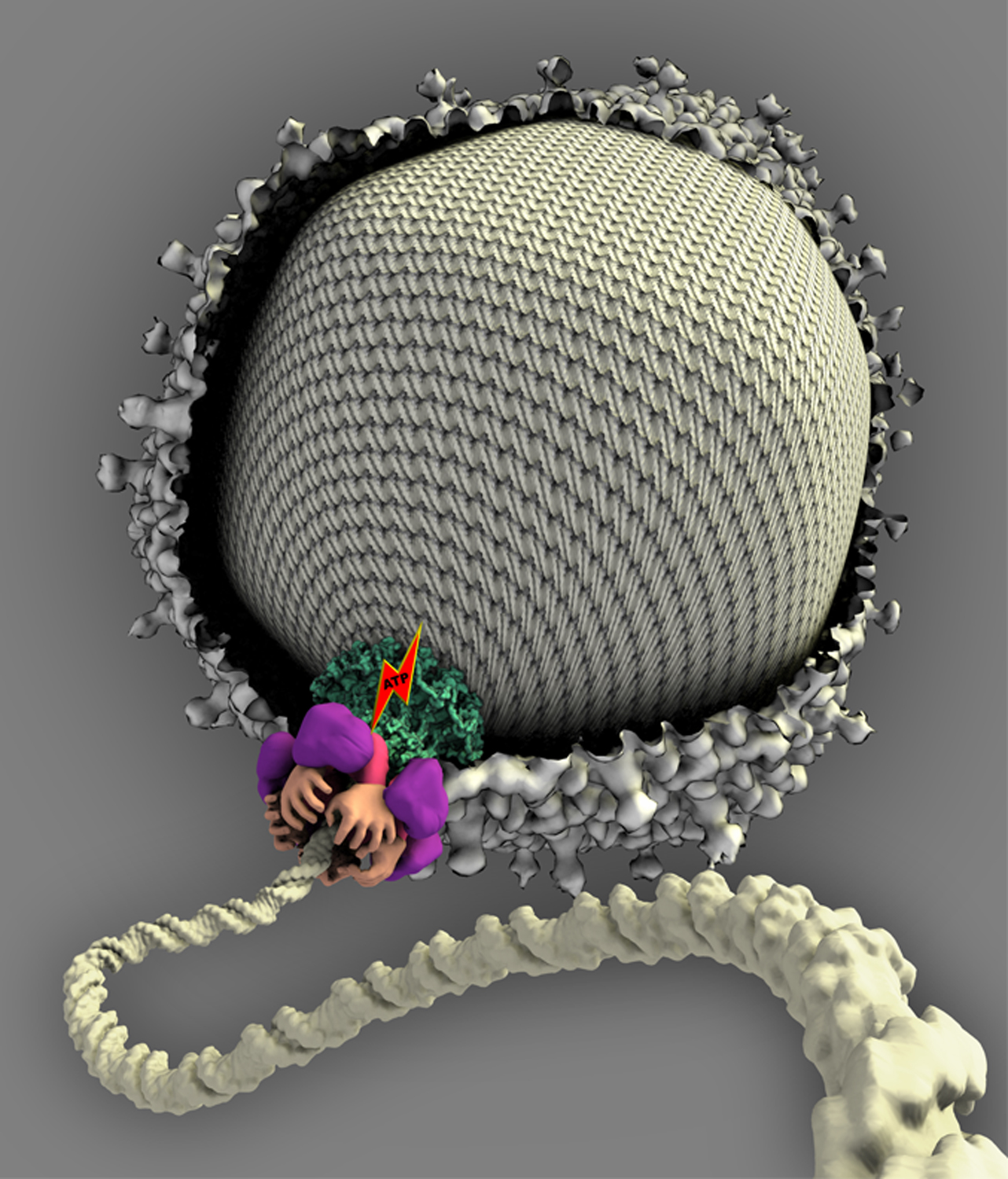
ScienceDaily (Dec. 31, 2008) — Peering at structures only atoms across, researchers have identified the clockwork that drives a powerful virus nanomotor.

clipped from news.uns.purdue.edu

Biologists learn structure, mechanism of powerful 'molecular motor' in virus

clipped from news.uns.purdue.edu
http://news.uns.purdue.edu/images/+2008/RossmannMotors.jpg
clipped from news.uns.purdue.edu

The motor is needed to insert DNA into the capsid of the T4 virus, which is called a bacteriophage because it infects bacteria. The same kind of motor, however, also is likely present in other viruses, including the human herpes virus.

"Molecular motors in double-stranded DNA viruses have never been shown in such detail before," said Siyang Sun, a postdoctoral research associate working in Rossmann's lab.

clipped from bio.purdue.edu
Purdue University

Biological Sciences

MICHAEL ROSSMANN


blog it
clipped from www.nsf.gov
National Science Foundation

Press Release 08-220
Viruses, Start Your Engines!

Researchers find what drives one of nature's powerful, nanoscale motors

Because of the motor's strength--to scale, twice that of an automobile--the new findings could inspire engineers designing sophisticated nanomachines. In addition, because a number of virus types may possess a similar motor, including the virus that causes herpes, the results may also assist pharmaceutical companies developing methods to sabotage virus machinery.

clipped from www.youtube.com

Virus as Nano Motors Part 1 of 3

clipped from www.youtube.com

Virus as Nano Motors Part 2 of 3

clipped from www.youtube.com

Virus as Nano Motors Part 3 of 3


blog it

Related:
Clockwork That Drives Powerful Virus Nanomotor Discovered
Biologists learn structure, mechanism of powerful 'molecular motor' in virus
Department Biological Sciences, Purdue University
nsf.gov - Office of Legislative and Public Affairs (OLPA) News - Viruses, Start Your Engines! - US National Science Foundation (NSF)
Viruses, start your engines!
Biologists learn structure, mechanism of powerful viral 'molecular motor' - R & D
What Drives One Of Nature's Powerful, Nanoscale Motors? - Health - redOrbit