Showing posts with label black holes. Show all posts

2012-05-30

Images of Stars Orbiting a Supermassive Black Hole

The Galactic Center Revisited (Gallery Explorer) - NASA Spitzer Space Telescope

Hiding behind the constellations Sagittarius and Scorpius is the center of our own Milky Way galaxy, over 25,000 light years away. This patch of sky is mostly dark in visible light, shrouded by dust clouds that lie between us and the Galactic center. But the infrared vision of NASA’s Spitzer Space Telescope sees through the dust showing us this strange and tumultuous region.


APOD: 2009 July 27 - NGC 1097: Spiral Galaxy with a Central Eye

What's happening at the center of spiral galaxy NGC 1097? No one is sure, but it likely involves a supermassive black hole. Matter falling in from a bar of stars and gas across the center is likely being heated by an extremely energetic region surrounding the central black hole. [...]

Supermassive black hole - Wikipedia, the free encyclopedia

A supermassive black hole is the largest type of black hole in a galaxy, on the order of hundreds of thousands to billions of solar masses. Most, and possibly all galaxies, including the Milky Way[2] (see Sagittarius A*), are believed to contain supermassive black holes at their centers.[3][4]

Image of the Day: Spectacular Ring of Stars Orbit a Monster Black Hole

The Daily Galaxy via NASA/Hubble Space Telescope and Spitzer
The image above of the central 5,500 light-years wide region of NGC 1097. More than 300 star forming regions - white spots in the image - are distributed along a ring of dust and gas. At the center is a bright central source where the active galactic nucleus and its super-massive black hole are located. About 40 thousand light-years from the larger galaxy's center, the gravity of the companion galaxy appears to be reshaping the larger galaxy as it is slowly being destroyed itself.

ESO - eso0534 - Feeding the Monster

Near-infrared images of the active galaxy NGC 1097, obtained with the NACO adaptive optics instrument on ESO's Very Large Telescope, disclose with unprecedented detail a complex central network of filamentary structure spiralling down to the centre of the galaxy. These observations provide astronomers with new insights on how super-massive black holes lurking inside galaxies get fed.


Colour-composite image of the central 5,500 light-years wide region of the spiral galaxy NGC 1097, obtained with the NACO adaptive optics on the VLT. More than 300 star forming regions - white spots in the image - are distributed along a ring of dust and gas in the image. At the centre of the ring there is a bright central source where the active galactic nucleus and its super-massive black hole are located. The image was constructed by stacking J- (blue), H- (green), and Ks-band (red) images. North is up and East is to the left. The field of view is 24 x 29 arcsec2, i.e. less than 0.03% the size of the full moon!


2012-05-10

NuSTAR: NASA's Black-Hole Hunter

NuSTAR NASA Black Hole Hunter with X-RAY Eyes - YouTube

A large number of galaxies are hiding black holes that we can't detect, and NASA's NuSTAR will use X-ray vision to find them.


Missions - NuSTAR - NASA Science

The Nuclear Spectroscopic Telescope Array is an Explorer mission that will allow astronomers to study the universe in high energy X-rays. Launching in 2012, NuSTAR will be the first focusing hard X-ray telescope to orbit Earth and is expected to greatly exceed the performance of the largest ground-based observatories that have observed this region of the electromagnetic spectrum. NuSTAR will also complement astrophysics missions that explore the cosmos in other regions of the spectrum.
X-ray telescopes such as Chandra and XMM-Newton have observed the X-ray universe at low X-ray energy levels. By focusing higher energy X-rays, NuSTAR will start to answer several fundamental questions about the Universe including:
  • How are black holes distributed through the cosmos?
  • How were heavy elements forged in the explosions of massive stars?
  • What powers the most extreme active galaxies?


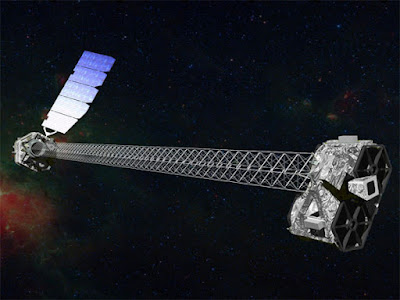
NASA's newest X-ray telescope will have a lengthy structure that unfolds in space, allowing it to see high-energy objects like feeding black holes. To view the video of mast deployment in space animation please click here.


Artist's concept of NuSTAR on orbit. NuSTAR has a 10-m (30') mast that deploys after launch to separate the optics modules (right) from the detectors in the focal plane (left). The spacecraft, which controls NuSTAR's pointings, and the solar panels are with the focal plane. NuSTAR has two identical optics modules in order to increase sensitivity. The background is an image of the Galactic center obtained with the Chandra X-ray Observatory. Image credit: NASA/JPL-Caltech

2012-03-08

Black Hole Simulations

Black hole - Wikipedia, the free encyclopedia

A black hole is a region of spacetime from which nothing, not even light, can escape.[1] The theory of general relativity predicts that a sufficiently compact mass will deform spacetime to form a black hole. Around a black hole there is a mathematically defined surface called an event horizon that marks the point of no return. It is called "black" because it absorbs all the light that hits the horizon, reflecting nothing, just like a perfect black body in thermodynamics.[2] Quantum mechanics predicts that black holes emit radiation like a black body with a finite temperature. This temperature is inversely proportional to the mass of the black hole, making it difficult to observe this radiation for black holes of stellar mass or greater.

Simulated view of a black hole (center) in front of the Large Magellanic Cloud. Note the gravitational lensing effect, which produces two enlarged but highly distorted views of the Cloud. Across the top, the Milky Way disk appears distorted into an arc.
Simulation of gravitational lensing by a black hole, which distorts the image of a galaxy in the background


Inside Black Holes


This is not an artist's impression.
It is a general relativistic volume-rendering
of a super-computed simulation.


  • Journey into the simplest kind of black hole, a black hole with mass, but no charge and no spin — a Schwarzschild black hole.
  • Journey into and through a charged black hole — a Reissner-Nordström black hole. This one has a wormhole and a white hole connecting to a new universe.
  • How to understand black holes — a black hole is a waterfall of space.
  • How does a scene appear when you pass through it at near the speed of light? — The rules of 4-dimensional perspective.
  • How to find your way inside black holes — Penrose diagrams.
  • Journey into a realistic (well, kind of) black hole — the wormhole is destroyed by the mass inflation instability.
  • The movies on this site were made with the Black Hole Flight Simulator.


2010-06-06

An Artificial Black Hole for Microwaves

Scientists create artificial mini 'black hole'

(PhysOrg.com) -- Scientists from China have built a device that can trap and absorb microwaves coming from all directions with a 99% absorption rate - a property that makes the device simulate, to some extent, an astrophysical black hole. 


(Left) A model of the electromagnetic omnidirectional absorber, in which electromagnetic waves hitting the cylinder bend spirally in the shell region, and become trapped and absorbed by the lossy core. (Right) A photograph of the device, which is composed of 60 concentric layers of copper-coated metamaterials. Image credit: Institute of Physics.


The Institute of Physics

Scientists create artificial mini “black hole”


3 June 2010

Chinese researchers have successfully built an electromagnetic absorbing device for microwave frequencies. The device, made of a thin cylinder comprising 60 concentric rings of metamaterials, is capable of absorbing microwave radiation, and has been compared to an astrophysical black hole (which, in space, soaks up matter and light).

The research published today, Thursday, 3 June, in New Journal of Physics (co-owned by the Institute of Physics and German Physical Society), shows how the researchers utilised the special properties of metamaterials, a class of ordered composites which can distort light and other waves.


An omnidirectional electromagnetic absorber made of metamaterials

Author
Qiang Cheng , Tie Jun Cui 1, Wei Xiang Jiang and Ben Geng Cai

GENERAL SCIENTIFIC SUMMARY

Introduction and background. An omnidirectional perfect electromagnetic absorber may have many applications in science and engineering, such as cross-talk reduction in optoelectronic devices or solar light harvesting. However, in reality, few of the actual materials come close to 100 per cent absorption of electromagnetic waves from all directions. It is possible to reach near total absorption based on existing methods, but this is generally limited to a specific range of incidence angles.

Main results. In this work, we realize an omnidirectional electromagnetic absorber for the first time in the microwave frequencies, based on a previous theoretical work using non-magnetic metamaterials. We designed and fabricated the omnidirectional absorbing device using non-resonant metamaterials in the external layer and resonant metamaterials in the internal core, and measured the electric-field distributions using the planar-waveguide near-field scanning apparatus. Experimental results show good agreement with full-wave numerical simulations. Numerical results show that the absorption rate can reach 99 per cent in the microwave frequency.

Wider implications. The designed omnidirectional absorbing device can trap and absorb electromagnetic waves coming from all directions spirally inwards without any reflections due to the local control of electromagnetic fields. Hence it behaves like an 'electromagnetic black body' or an 'electromagnetic black hole' to some extent. Since the lossy core of the device can transfer the electromagnetic energies into heat energies, it is expected that the omnidirectional absorber could find important applications in thermal emitting and electromagnetic-wave harvesting. The more important message is that artificial metamaterials will prove remarkably more helpful and more useful for modern science and engineering.

Figure. The simulation results for a perfect omnidirectional electromagnetic absorber.


Metamaterial

Metamaterials are artificial materials engineered to provide properties which may not be readily available in nature. These materials usually gain their properties from structure rather than composition, using the inclusion of small inhomogeneities to enact effective macroscopic behavior.

The primary research in metamaterials investigates materials with negative refractive index Negative refractive index materials appear to permit the creation of superlenses which can have a spatial resolution below that of the wavelength. In other work, a form of 'invisibility' has been demonstrated at least over a narrow wave band with gradient-index materials. Although the first metamaterials were electromagnetic acoustic and seismic metamaterials are also areas of active research.


Sources
Scientists create artificial mini 'black hole'
http://www.physorg.com/news194788240.html
Scientists create artificial mini “black hole”
http://www.iop.org/News/news_41415.html
An omnidirectional electromagnetic absorber made of metamaterials
http://iopscience.iop.org/1367-2630/12/6/063006
Metamaterial - Wikipedia, the free encyclopedia
http://en.wikipedia.org/wiki/Meta_materials

Related
Scientists create artificial mini 'black hole'
http://www.sciencedaily.com/releases/2010/06/100603091829.htm
Scientists create artificial mini 'black hole'
http://www.physorg.com/news194788240.html
1367-2630_12_6_063006.pdf - Powered by Google Docs
http://docs.google.com/viewer?url=http://iopscience.iop.org/1367-2630/12/6/063006/pdf/1367-2630_12_6_063006.pdf
How to Create a Black Hole on a Lab Bench | 80beats | Discover Magazine
http://blogs.discovermagazine.com/80beats/2009/10/14/how-to-create-a-black-hole-on-a-lab-bench/
Researchers Create an Electromagnetic "Black Hole" the Size of a Salad Plate: Scientific American
http://www.scientificamerican.com/article.cfm?id=electromagnetic-black-hole
Scientists Make Desktop Black Hole | Wired Science | Wired.com
http://www.wired.com/wiredscience/2009/10/desktop-black-hole/
First black hole for light created on Earth - physics-math - 14 October 2009 - New Scientist
http://www.newscientist.com/article/dn17980-first-black-hole-for-light-created-on-earth.html
Technology Review: Blogs: arXiv blog: Artificial Black Hole Created in Chinese Lab
http://www.technologyreview.com/blog/arxiv/24234/
Scientists Create Artificial Mini 'Black Hole': An Omnidirectional Electromagnetic Absorber Made Of Metamaterials | Before It's News
http://beforeitsnews.com/news/72/578/Scientists_Create_Artificial_Mini_Black_Hole:_An_Omnidirectional_Electromagnetic_Absorber_Made_Of_Metamaterials.html

2010-04-10

Our Universe Within a Larger Universe

Black Holes and Worm Holes


Clipped from: wormhole

wormhole


A hypothetical "tunnel" connecting two different points in spacetime in such a way that a trip through the wormhole could take much less time than a journey between the same starting and ending points in normal space. The ends of a wormhole could, in theory, be intra-universe (i.e. both exist in the same universe) or inter-universe (exist in different universes, and thus serve as a connecting passage between the two). 

[...]

The theory of wormholes goes back to 1916, shortly after Einstein published his general theory, when Ludwig Flamm, an obscure Austrian physicist, looked at the simplest possible solution of Einstein's field equations, known as the Schwarzschild solution (or Schwarzschild metric). This describes the gravitational field around a spherically-symmetric non-rotating mass. If the mass is sufficiently compact, the solution describes a particular form of the phenomenon now called a black hole – the Schwarzschild black hole. Flamm realized that Einstein's equations allowed a second solution, now known as a white hole, and that the two solutions, describing two different regions of (flat) spacetime were connected (mathematically) by a spacetime conduit.1 Because the theory has nothing to say about where these regions of spacetime might be in the real world, the black hole "entrance" and white hole "exit" could be in different parts of the same universe or in different universes.


Our universe at home within a larger universe? So suggests wormhole research

(PhysOrg.com) -- Could our universe be located within the interior of a wormhole which itself is part of a black hole that lies within a much larger universe?

Such a scenario in which the is born from inside a wormhole (also called an Einstein-Rosen Bridge) is suggested in a paper from Indiana University theoretical physicist Nikodem Poplawski in Physics Letters B. The final version of the paper was available online March 29 and will be published in the print edition April 12.

Poplawski takes advantage of the Euclidean-based coordinate system called isotropic coordinates to describe the of a black hole and to model the radial geodesic motion of a massive particle into a black hole.


Einstein-Rosen bridges like the one visualized above have never been observed in nature, but they provide theoretical physicists and cosmologists with solutions in general relativity by combining models of black holes and white holes.


Our universe at home within a larger universe? So suggests IU theoretical physicist's wormhole research

IU theoretical physicist Nikodem Poplawski in research published in "Physics Letters B" uses Euclidean-based mathematical modeling to suggest that all black holes may have wormholes inside which exist universes created at the same time as the black holes.

In studying the radial motion through the event horizon (a black hole's boundary) of two different types of black holes -- Schwarzschild and Einstein-Rosen, both of which are mathematically legitimate solutions of general relativity -- Poplawski admits that only experiment or observation can reveal the motion of a particle falling into an actual black hole. But he also notes that since observers can only see the outside of the black hole, the interior cannot be observed unless an observer enters or resides within.

"This condition would be satisfied if our universe were the interior of a black hole existing in a bigger universe," he said. "Because Einstein's general theory of relativity does not choose a time orientation, if a black hole can form from the gravitational collapse of matter through an event horizon in the future then the reverse process is also possible. Such a process would describe an exploding white hole: matter emerging from an event horizon in the past, like the expanding universe."

A white hole is connected to a black hole by an Einstein-Rosen bridge (wormhole) and is hypothetically the time reversal of a black hole. Poplawski's paper suggests that all astrophysical black holes, not just Schwarzschild and Einstein-Rosen black holes, may have Einstein-Rosen bridges, each with a new universe inside that formed simultaneously with the black hole.
Sources:
  1. YouTube - Black Holes and Worm Holes
  2. wormhole
  3. Our universe at home within a larger universe? So suggests wormhole research
  4. Our universe at home within a larger universe? So suggests IU theoretical physicist's wormhole research: IU News Room: Indiana University
Related:
  1. Is Our Universe Inside Another Larger Universe? | Universe Today
  2. Our universe at home within a larger universe? So suggests physicist's wormhole research
  3. Our universe at home within a larger universe? So suggests physicist's wormhole research
  4. Did a Theoretical Physicist Already Predict the End of Lost? | Popular Science
  5. Wormhole - Wikipedia, the free encyclopedia
  6. Department of Physics, Indiana University: Nikodem Poplawski
  7. [0902.1994] Radial motion into the Einstein-Rosen bridge
  8. 0902.1994v2.pdf - Powered by Google Docs

2010-04-07

Nanoscale Atomic 'Black Holes'

Harvard University

Understanding tiny reactions

Cold atoms and nanotubes come together in atomic 'black hole'


Launched laser-cooled atoms are captured by a single, suspended, single-wall carbon nanotube charged to hundreds of volts. A captured atom spirals toward the nanotube (white path) and reaches the environs of the tube surface, where its valence electron (yellow) tunnels into the tube. The resulting ion (purple) is ejected and detected, and the dynamics at the nanoscale are sensitively probed.

Carbon nanotubes, long touted for applications in electronics and in materials, may also be the stuff of atomic-scale black holes.


Physicists at Harvard University have found that a high-voltage nanotube (a tiny tubelike structure) can cause cold atoms to spiral inward under dramatic acceleration before disintegrating violently. The physicists’ experiments, which are the first to demonstrate something akin to a black hole at atomic scale, are described in the current issue of the journal Physical Review Letters.


Cold Atoms and Nanotubes Come Together in an Atomic 'Black Hole'


"On a scale of nanometers, we create an inexorable and destructive pull similar to what black holes exert on matter at cosmic scales," says Lene Vestergaard Hau, Mallinckrodt Professor of Physics and of Applied Physics at Harvard. "As importantly for scientists, this is the first merging of cold-atom and nanoscale science, and it opens the door to a new generation of cold atom experiments and nanoscale devices."


Phys. Rev. Lett. 104, 133002 (2010) [4 pages]

Field Ionization of Cold Atoms near the Wall of a Single Carbon Nanotube


We observe the capture and field ionization of individual atoms near the side wall of a single suspended nanotube. Extremely large cross sections for ionization from an atomic beam are observed at modest voltages due to the nanotube’s small radius and extended length. The effects of the field strength on both the atomic capture and the ionization process are clearly distinguished in the data, as are prompt and delayed ionizations related to the locations at which they occur. Efficient and sensitive neutral atom detectors can be based on the nanotube capture and wall ionization processes.


Sources:
  1. Understanding tiny reactions | Harvard Gazette Online
  2. Cold atoms and nanotubes come together in an atomic 'black hole'
  3. Phys. Rev. Lett. 104, 133002 (2010): Field Ionization of Cold Atoms near the Wall of a Single Carbon Nanotube
Related:
  1. Understanding tiny reactions: Cold atoms and nanotubes come together in atomic 'black hole'
  2. Cold atoms and nanotubes come together in an atomic 'black hole'
  3. Nanoscale Atomic 'Black Holes' - Technology News - redOrbit
  4. Hau Lab at Harvard
  5. Lene Vestergaard Hau
  6. Q&A with Lene Hau - The Boston Globe

2009-04-17

Descent into a Black Hole

Clipped from: Technology Review: Blogs: arXiv blog: A black hole with a view

A black hole with a view

Physicists have calculated what the universe would look like from inside a black hole, and not just for fun

Ever wondered what it's like to fall into a black hole? Wonder no more! Andrew Hamilton at JILA at the University of Colorado and a pal, Gavin Polhemus, have created a video showing what it might look like

Clipped from: YouTube - Descent into a Black Hole

Descent into a Black Hole


Clipped from: Inside Black Holes

Inside Black Holes

What really happens inside black holes? Are there wormholes inside black holes? Do black holes give birth to baby universes? These questions lie at the frontier of research into relativity. The aim of this website is to take you to the frontier, and maybe even a bit beyond it.

This is a general relativistic visualization of a supercomputed magneto-hydrodynamic simulation of a disk and jet around a black hole. The disk and jet were supercomputed by John Hawley at the University of Virginia. The general relativistic rendering was done with the Black Hole Flight Simulator.

Clipped from: YouTube - Black Holes

Black Holes


Clipped from: Black hole - Wikipedia, the free encyclopedia
In general relativity, a black hole is a region of space in which the gravitational field is so powerful that nothing, including light, can escape its pull. The black hole has a one-way surface, called the event horizon, into which objects can fall, but never emerge from. It is called "black" because it absorbs all the light that hits it, reflecting nothing, just like a perfect blackbody in thermodynamics. Quantum analysis of black holes shows them to possess a temperature and radiate like black bodies.

Despite its invisible interior, a black hole can reveal its presence through interaction with other matter. A black hole can be inferred by tracking the movement of a group of stars that orbit a region in space which looks empty. Alternatively, one can see gas falling into a relatively small black hole, from a companion star. This gas spirals inward, heating up to very high temperature and emitting large amounts of radiation that can be detected from earthbound and earth-orbiting telescopes. Such observations have resulted in the general scientific consensus that, barring a breakdown in our understanding of nature, black holes do exist in our universe.[2]


Sources:
  1. Technology Review: Blogs: arXiv blog: A black hole with a view
  2. YouTube - Descent into a Black Hole
  3. Inside Black Holes
  4. YouTube - Black Holes
  5. Black hole - Wikipedia, the free encyclopedia

Related:
  1. Discovery Space: Twisted Physics: A Singular Sensation
  2. Maximizing Survival Time Inside the Event Horizon of a Black Hole | Universe Today


2008-02-13

SUGAR -- Detecting Black Holes from Gravity Waves

Gravitational waves are predicted by Einstein's 1916 general theory of relativity, but they are notoriously hard to detect and it's taken many decades to come close to observing them. Now, with the help of a supercomputer named SUGAR (Syracuse University Gravitational and Relativity Cluster), two years of data collected by the Laser Interferometer Gravitational-Wave Observatory (LIGO) will be analyzed to find gravitational waves. Once detected, it is hoped that the location of some of the Universes most powerful collisions and explosions will be found, perhaps even hearing the distant ringing of celestial black holes…
Universe Today » "Listening" for Gravitational Waves to Track Down Black Holes


Syracuse University Gravitational Wave Group: Sources and Simulations

ScienceDaily: Your source for the latest research news  and science breakthroughs -- updated daily
ScienceDaily (Feb. 10, 2008) — Scientists hope that a new supercomputer being built by Syracuse University's Department of Physics may help them identify the sound of a celestial black hole. The supercomputer, dubbed SUGAR (SU Gravitational and Relativity Cluster), will soon receive massive amounts of data from the California Institute of Technology (Caltech) that was collected over a two-year period at the Laser Interferometer Gravitational-Wave Observatory (LIGO).
Listening For The Cosmic Symphony: Supercomputer Will Help Scientists Listen For Black Holes

Related:
The Light Cone: The Schwarzschild Black Hole

Blogged with Flock