Showing posts with label NASA. Show all posts

2012-11-10

NASA Planning Deep-Space Outpost Near the Moon

NASA to announce new manned moon missions? | Crave - CNET

It has been almost 40 years since the Apollo 17 mission last landed a man on the moon. It may not take anywhere near that long before we send astronauts back to the moon's neighborhood.

Space.com reports that NASA is seriously looking at sending out a new manned moon mission with the purpose of creating a manned outpost beyond the far side of moon and eventually visiting an asteroid in 2025. This may not physically land a human on the moon, but it would establish a deep space outpost as a base for research and missions.

NASA May Unveil New Manned Moon Missions Soon | Space.com

Artist's concept of astronauts in an Orion capsule helping direct robotic teleoperations on the moon's farside. CREDIT: Lockheed Martin

"NASA has been evolving its thinking, and its latest charts have inserted a new element of cislunar/lunar gateway/Earth-moon L2 sort of stuff into the plan," Logsdon told SPACE.com. (The Earth-moon L2 is a so-called libration point where the two bodies' gravitational pulls roughly balance out, allowing spacecraft to essentially park there.) [Gallery: Visions of Deep-Space Station Missions]


NASA Eyes Plan for Deep-Space Outpost Near the Moon

The Lagrange points for the Earth-moon system. NASA is evaluating an early mission with the Orion capsule placed at Earth-moon L2. Astronauts parked there could teleoperate robots on the lunar farside.
CREDIT: David A. Kring, LPI-JSC Center for Lunar Science and Exploration

Could moon outpost propel space travel? Fmr. Astronaut Leroy Chiao weighs in – Early Start with John Berman & Zoraida Sambolin - CNN.com Blogs

What if astronauts were to return to the moon? Decades after man first landed on the moon, Space.com is reporting that it’s possible.
A space policy expert told the website that plans are in the works by NASA to travel back to the vicinity of the moon and create a manned outpost there in order to learn more about future deep-space travel. The manned outpost could eventually be used as a staging area for future missions to the moon. This morning on "Early Start," fmr. Astronaut and International Space Station Commander Leroy Chiao explains.

NASA to deploy water-seeking robot on Moon in 2017, manned lunar base could be next | The Verge

50 years ago, President John F. Kennedy told the United States that man would go to the moon. Soon, another American president may announce that the same celestial body will serve as a waypoint for manned space exploration. The Verge has learned that NASA intends to deploy a robotic lunar rover on the Moon in 2017 to search for water and other resources necessary for space travel, and that NASA may have secured support from the White House for an actual manned outpost — a space station — floating above the far side of the moon. Rumors of such a deep-space outpost surfaced as early as February of this year, when a leaked memo from a NASA administrator detailed an idea to build a "human-tended waypoint" at Earth-Moon Lagrange Point 2 (EML-2): a point in space where balanced gravitational forces allow an object to remain in stationary orbit relative to both the Earth and the Moon. From there, NASA could launch missions deeper into space — say, to Mars, or a near-Earth asteroid — using the base as a stepping stone.


2012-07-29

NASA's new Space Launch System (SLS)

Space Launch System - Wikipedia, the free encyclopedia

The Space Launch System, or SLS, is a United States Space Shuttle-derived heavy launch vehicle being designed by NASA. It follows the cancellation of the Constellation Program, and is to replace the retired Space Shuttle.

[...}

SLS is to take astronauts and hardware to such destinations as near-Earth objects like asteroids, Lagrange points, the Moon, and Mars. SLS may also to support trips to the International Space Station, if necessary. The SLS Program is integrated with NASA's Orion Program, providing a multipurpose crew vehicle. SLS will use the ground operations and launch facilities at NASA's Kennedy Space Center, Florida.

Giant deep-space rocket passes key test - Technology & science - Space - Space.com - NBCNews.com


NASA's next-generation rocket, a behemoth of a booster expected to launch astronauts deeper into space than ever before, has passed a major design milestone, space agency officials announced Wednesday.

The new mega-rocket, called the Space Launch System, passed a series of reviews that laid out the technical, performance, cost and schedule requirements for the heavy-lift booster. The completion of the so-called System Requirements Review and System Definition Review allows program managers to proceed into the rocket's preliminary design phase, NASA officials said.


NASA - NASA's Space Launch System Passes Major Agency Review, Moves to Preliminary Design


The first test flight of NASA's Space Launch System, which will feature a configuration for a 70-metric-ton (77-ton) lift capacity, is scheduled for 2017. As SLS evolves, a three-stage launch vehicle configuration will provide a lift capability of 130 metric tons (143 tons) to enable missions beyond low Earth orbit and support deep space exploration.
An expanded view of an artist rendering of the 70-metric-ton configuration of NASA's Space Launch System. (NASA)

An expanded view of an artist rendering of the 130 metric ton configuration of NASA's Space Launch System. (NASA)

NASA - Multimedia - Video Gallery


Space Launch System: Future Frontier

Featuring NASA Marshall’s Foundations of Influence, Relationships, Success & Teamwork (FIRST) employees and student interns, "Future Frontier" discusses the new Space Launch System (SLS) heavy-lift launch vehicle and its importance to furthering NASA's exploration mission. NASA FIRST is the Agency's leadership program for promising young professionals. (NASA/MSFC)


2012-05-10

NuSTAR: NASA's Black-Hole Hunter

NuSTAR NASA Black Hole Hunter with X-RAY Eyes - YouTube

A large number of galaxies are hiding black holes that we can't detect, and NASA's NuSTAR will use X-ray vision to find them.


Missions - NuSTAR - NASA Science

The Nuclear Spectroscopic Telescope Array is an Explorer mission that will allow astronomers to study the universe in high energy X-rays. Launching in 2012, NuSTAR will be the first focusing hard X-ray telescope to orbit Earth and is expected to greatly exceed the performance of the largest ground-based observatories that have observed this region of the electromagnetic spectrum. NuSTAR will also complement astrophysics missions that explore the cosmos in other regions of the spectrum.
X-ray telescopes such as Chandra and XMM-Newton have observed the X-ray universe at low X-ray energy levels. By focusing higher energy X-rays, NuSTAR will start to answer several fundamental questions about the Universe including:
  • How are black holes distributed through the cosmos?
  • How were heavy elements forged in the explosions of massive stars?
  • What powers the most extreme active galaxies?


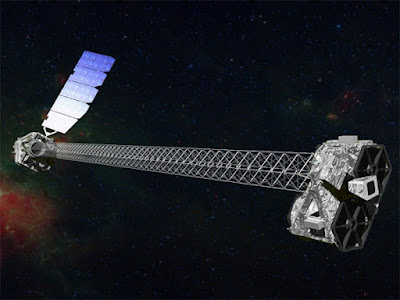
NASA's newest X-ray telescope will have a lengthy structure that unfolds in space, allowing it to see high-energy objects like feeding black holes. To view the video of mast deployment in space animation please click here.


Artist's concept of NuSTAR on orbit. NuSTAR has a 10-m (30') mast that deploys after launch to separate the optics modules (right) from the detectors in the focal plane (left). The spacecraft, which controls NuSTAR's pointings, and the solar panels are with the focal plane. NuSTAR has two identical optics modules in order to increase sensitivity. The background is an image of the Galactic center obtained with the Chandra X-ray Observatory. Image credit: NASA/JPL-Caltech

2012-03-27

Perpetual Ocean -- Ocean Surface Currents Animation

Last year, a group of NASA scientists and animators put together this animation of the world’s ocean surface currents, based on ocean flow data for June 2005 to December 2007. The video starts over the Atlantic, and as the globe rotates, you can see the whorls and waves dancing across the ocean, the relative calm of the Pacific, and the stillness around Antarctica. [...] The tool NASA used to make the visualization — ECCO2 or Estimating the Circulation and Climate of the Ocean


ECCO2 Home Page

To increase understanding and predictive capability for the ocean's role in future climate change scenarios, the NASA Modeling, Analysis, and Prediction (MAP) program is funding a project called Estimating the Circulation and Climate of the Ocean, Phase II (ECCO2): High-Resolution Global-Ocean and Sea-Ice Data Synthesis. ECCO2 aims to produce increasingly accurate syntheses of all available global-scale ocean and sea-ice data at resolutions that start to resolve ocean eddies and other narrow current systems, which transport heat, carbon, and other properties within the ocean.


2012-03-04

Watching the Planet Breathe: Global CO2 Monitoring from Space


CO2 can enter the atmosphere from a variety of sources, which can be natural or anthropogenic. For example, some natural sources are rotting plants, forest fires and ordinary breathing. Automobiles, factories and home heating units burn fossil fuels such as oil, coal and natural gas. Burning these fossil fuels releases CO2 into the atmosphere. These activities add to the emission of CO2 into the atmosphere.

Processes that absorb CO2 from the atmosphere are often referred to as sinks. Several natural processes remove CO2 from the atmosphere. Plants, for example, use sunlight to photosynthesize CO2 and water into sugar and other carbohydrates. Oceans also absorb atmospheric CO2, whereafter, sea creatures incorporate the dissolved CO2 into their shells. After these creatures die, their shells fall to the bottom of the ocean and eventually form carbonate rocks. The complete process of CO2 exchange (taking into account both sources and sinks) is known as the carbon cycle.

Source: : Mission

Watching the planet breathe

Launched in 2009, the Japanese satellite Greenhouse Gases Observing Satellite (GOSAT) has the ability to pick up this glow. Using GOSAT data, JPL scientist Christian Frankenberg and colleagues have shown that it is possible to pick up this fluorescent glow from space over the entire planet, and thereby infer details about the health and activity of vegetation on the ground.

(A) Global map of plant chlorophyll fluorescence as measured by the GOSAT satellite from June 2009 to May 2010. The fluorescence is measured at a spectral wavelength of 757 nanometers and superimposed on a 2°x 2° grid. Areas of higher and lower plant activity can be seen in different parts of the world. (B) Time variations in the fluorescence signal given off by vegetation, from June 2009 to August 2010. A pronounced seasonal variation can be seen that reflects the growing season in the northern hemisphere and seasonal vegetation shifts in the tropics.
Together, GOSAT and OCO-2 will provide an unprecedented amount of information on the health of plants and carbon dioxide levels of our planet. The hope is that this will give us a much better grip on the Earth’s carbon cycle -- and therefore climate change.


2012-02-25

Buckyball Solids Found in Space

Nasa's Spitzer telescope spots first solid buckyballs in space (Wired UK)


After finding gaseous clouds of buckyballs in space last year, astronomers have now discovered the carbon balls in a solid form, around a pair of stars some 6,500 light-years from Earth.

Buckyballs are microscopic spheres, where 60 carbon atoms are arranged -- with alternating patterns of hexagons and pentagons -- into a football-like pattern. The unusual structure makes them incredibly strong, and ideal candidates for things like superconducting materials, medicines, water purification and armour.

NASA - NASA's Spitzer Finds Solid Buckyballs in Space


"These buckyballs are stacked together to form a solid, like oranges in a crate," said Nye Evans of Keele University in England, lead author of a paper appearing in the Monthly Notices of the Royal Astronomical Society. "The particles we detected are minuscule, far smaller than the width of a hair, but each one would contain stacks of millions of buckyballs."

Buckyballs were detected definitively in space for the first time by Spitzer in 2010. Spitzer later identified the molecules in a host of different cosmic environments. It even found them in staggering quantities, the equivalent in mass to 15 Earth moons, in a nearby galaxy called the Small Magellanic Cloud.

In all of those cases, the molecules were in the form of gas. The recent discovery of buckyballs particles means that large quantities of these molecules must be present in some stellar environments in order to link up and form solid particles. The research team was able to identify the solid form of buckyballs in the Spitzer data because they emit light in a unique way that differs from the gaseous form.

"This exciting result suggests that buckyballs are even more widespread in space than the earlier Spitzer results showed," said Mike Werner, project scientist for Spitzer at NASA's Jet Propulsion Laboratory in Pasadena, Calif. "They may be an important form of carbon, an essential building block for life, throughout the cosmos."


Buckminsterfullerene - Wikipedia, the free encyclopedia

Buckminsterfullerene (or buckyball) is a spherical fullerene molecule with the formula C60. It is a cage-like fused-ring structure (truncated (T = 3) icosahedron) which resembles an association football ball, made of twenty hexagons and twelve pentagons, with a carbon atom at the vertices of each polygon and a bond along each polygon edge.

It was first intentionally prepared in 1985 by Harold Kroto, James R. Heath, Sean O'Brien, Robert Curl and Richard Smalley at Rice University.[2] Kroto, Curl and Smalley were awarded the 1996 Nobel Prize in Chemistry for their roles in the discovery of buckminsterfullerene and the related class of molecules, the fullerenes. The name is a homage to Buckminster Fuller, as C60 resembles his trademark geodesic domes. Buckminsterfullerene was the first fullerene molecule discovered and it is also the most common in terms of natural occurrence, as it can be found in small quantities in soot.[3][4] Solid and gaseous forms of the molecule have been detected in deep space.[5]

Buckminsterfullerene is the largest matter to have been shown to exhibit wave–particle duality.[6] Its discovery lead to the exploration of a new field of chemistry, involving the study of fullerenes.


2012-02-17

NASA's Deep Space Outpost Near the Moon

NASA plans manned Deep Space Moon outpost • The Register

NASA is looking at the possibility of parking a manned outpost beside the Moon as a way station for astronauts on their way to deep space missions.

According to a memo from William Gerstenmaier, NASA's associate administrator for human exploration and operations, cited by Space.com, the agency is putting together a team to assess the possibilities of a potential location on the far side of the Moon known as Earth-Moon libration point 2 (EML-2).

Libration, or Lagrangian, points are parking spots in space where a small object is equally affected by the gravitational pull of two large masses, which cancel each other out, holding the craft in place.

DailyTech - NASA Preparing to Explore Earth-Moon Libration Point 2

The Lagrange points for the Earth-moon system

There are five libration points, or Lagrangian points, which mark positions where the combined gravitational pull of two large masses provides the centripetal force needed to rotate with them. This combined gravitational pull of the two large masses balance each other out, and spacecraft is able to basically park in this stationary spot.

Exploration and potential use of EML-2, which is located near the lunar far side, could open up the use of telerobotic science on the far side of the moon and provide a platform for radio astronomy as well as solar and Earth observation. It could also enable assembly and servicing of satellites and telescopes. NASA sees the effort eventually creating international partnerships as well as new opportunities with commercial companies and academic institutions.


EML-2 could serve as a gateway for capability-driven exploration of multiple destinations, such as near-lunar space, asteroids, the moon, the moons of Mars and, ultimately, Mars itself, according to NASA officials.

A capabilities-driven NASA architecture is one that should use the agency's  planned heavy-lift rocket, known as the Space Launch System, and the Orion Multi-Purpose Crew Vehicle "as the foundational elements."


2012-02-03

NASA's GRAIL First Video of Far Side of the Moon

Far side of the Moon - Wikipedia, the free encyclopedia

Far side of the Moon, photographed by Apollo 16

The far side of the Moon, also called the dark side of the Moon, is the lunar hemisphere that is permanently turned away, and not visible from the surface of the Earth.
[...]
Tidal forces from Earth have slowed down the moon's rotation so that the same side is always facing the Earth, a phenomenon called tidal locking. The other face, most of which is never visible from the Earth (18% of it can be observed over time due to libration), is therefore called the "far side of the Moon". The far side should not be confused with the "dark side" (the hemisphere that is not illuminated by the Sun at a given point in time), as the two are the same only during a full moon and, during a new moon, the near side is the dark side. Both the near and far sides receive (on average) almost equal amounts of light from the Sun. However, the term "dark side of the moon" is commonly used poetically to refer to the far side.[1]

NASA orbiter gives glimpse of moon's far side - CNN.com

The GRAIL mission's Ebb spacecraft took this picture of the south pole of the far side of the moon.

STORY HIGHLIGHTS
  • A 30-second NASA video scans the far side of the moon
  • It came from one of two probes that entered lunar orbit around New Year's
  • Ebb and Flow are to chart lunar gravitational field for 82 days


GRAIL consists of two identical spacecraft, recently named Ebb and Flow, each of which is equipped with a MoonKAM. The images were taken as part of a test of Ebb's MoonKAM on Jan. 19. The GRAIL project plans to test the MoonKAM aboard Flow at a later date.

[...]

Launched in September 2011, Ebb and Flow periodically perform trajectory correction maneuvers that, over time, will lower their orbits to near-circular ones with an altitude of about 34 miles (55 kilometers). During their science mission, the duo will answer longstanding questions about the moon and give scientists a better understanding of how Earth and other rocky planets in the solar system formed.


NASA - GRAIL Artist's Rendition


Using a precision formation-flying technique, the twin GRAIL spacecraft will map the moon's gravity field, as depicted in this artist's rendering. Radio signals traveling between the two spacecraft provide scientists the exact measurements required as well as flow of information not interrupted when the spacecraft are at the lunar farside, not seen from Earth. The result should be the most accurate gravity map of the moon ever made.


2011-12-24

SPHERES Nasa's Free-Flying Smart Spheres

Nasa tests floating robot servant for Space Station powered by Android phone | Mail Online

Floating robots are everywhere in science fiction. But the difficulty of keeping a heavy object 'floating' on earth has ensured they remain thoroughly ficitonal on our planet.

But in the low-gravity environment of the International Space Station, 240 miles up, it's a different matter.

Nasa has just completed trials of a real, floating robot - a free-flying Smart Sphere which is controlled by a Samsung Nexus phone.
A Nasa astronaut controls one of the Smart Spheres in testing on the Space Station last month: The robots can fly, navigate and record information all by themselves


The Human Exploration Telerobotics project, one of NASA's new, high-value Technology Demonstration Missions, equipped the compact, free-flying satellites -- known as Synchronized Position Hold, Engage, Reorient Experimental Satellites, or SPHERES -- with a Samsung Nexus S™ handset that features Google’s open-source Android™ platform.

Each volleyball-sized SPHERES has its own onboard power, propulsion, computing and navigational software. Adding the smartphone transforms the satellite into a free-flying robot, or "Smart SPHERES" -- complete with a compact, low-power, low-cost embedded computer and built-in cameras and sensors to enhance and expand robotic operations.


NASA - The Force is Strong with NASA's Smartphone-Powered Satellite

This close-up view shows three bowling-ball-sized free-flying satellites called Synchronized Position Hold, Engage, Reorient, Experimental Satellites (SPHERES) in the Destiny laboratory of the International Space Station. Image Credit: NASA.

MIT undergrads flight-test a prototype droid onboard NASA's KC-135 reduced gravity aircraft. Image Credit: NASA.


SPHERES

The MIT Space Systems Laboratory developed the SPHERES (Synchronized Position Hold Engage and Reorient Experimental Satellites) laboratory environment to provide DARPA, NASA, and other researchers with a long term, replenishable, and upgradable testbed for the validation of high risk metrology, control, and autonomy technologies for use in formation flight and autnomous docking, rendezvous and reconfiguration algorithms. These technologies are critical to the operation of distributed satellite and docking missions such as Terrestrial Planet Finder and Orbital Express.

To approximate the dynamics that will be encountered during these missions, the testbed consists of three small, self-contained vehicles, or "spheres," which can control their relative positions and orientations, and is operable on a 2-D laboratory platform, NASA's KC-135, and the International Space Station. SPHERES draws upon the MODE family of dynamics and control laboratories (STS-40, 42, 48, 62, MIR) by providing a cost-effective laboratory with direct astronaut interaction that exploits the micro-gravity conditions of space.

Here is a video of a recent Test Session aboard the ISS:


Source: SPHERES


2011-12-08

NASA's Dawn Spacecraft Reveals Details of Giant Asteroid Vesta

4 Vesta - Wikipedia, the free encyclopedia


Vesta, formally designated 4 Vesta, is one of the largest asteroids, with a mean diameter of about 530 kilometres (330 mi).[1]

[...]

NASA's Dawn spacecraft entered orbit around Vesta on July 16, 2011 for a planned one-year exploration, and what is known about Vesta will be refined and extended as data from Dawn is received, analyzed and published.


'As the Asteroid Turns' - YouTube

See asteroid Vesta spin before your very eyes. In this movie, strung together from a series of images provided by the framing camera on NASA's Dawn spacecraft, we see a full rotation of Vesta, which occurs over the course of roughly five hours. These images were obtained on July 24, 2011, from a distance of about 3,200 miles (5,200 kilometers).


NASA - New NASA Dawn Visuals Show Vesta's 'Color Palette'

Vesta appears in a splendid rainbow-colored palette in new images obtained by NASA's Dawn spacecraft. The colors, assigned by scientists to show different rock or mineral types, reveal Vesta to be a world of many varied, well-separated layers and ingredients. Vesta is unique among asteroids visited by spacecraft to date in having such wide variation, supporting the notion that it is transitional between the terrestrial planets -- like Earth, Mercury, Mars and Venus -- and its asteroid siblings.

In images from Dawn's framing camera, the colors reveal differences in the rock composition associated with material ejected by impacts and geologic processes, such as slumping, that have modified the asteroid's surface. [...]

Dawn Mission: Mission

Dawn, as a mission belonging to NASA’s Discovery Program, delves into the unknown, drives new technology innovations, and achieves what's never been attempted before. In Dawn’s case, it is orbiting  one member of the main asteroid belt, Vesta, before heading to gather yet more data at a second, Ceres. [...]


2011-08-25

NASA's Laser Communications Relay Demonstration Mission: The Ultimate Space Wi-Fi

Nasa develops laser space communications | Emerging Tech | ZDNet UK
http://www.zdnet.co.uk/news/emerging-tech/2011/08/24/nasa-develops-laser-space-communications-40093763

NASA to Test Ultimate Space Wifi : Discovery News
http://news.discovery.com/space/web-streaming-from-mars-110824.html
  • THE GIST
    • Laser communications could boost space data transmission rates from the speeds of dial-up to broadband.
    • The demonstration will pave the way for a communications system to be included on a future satellite.
    • NASA plans to test a full-size solar sail for chemical-free propulsion and a deep space atomic clock.
NASA - Communications, Navigation And In-Space Propulsion Technologies Selected For NASA Flight Demonstration
http://www.nasa.gov/home/hqnews/2011/aug/HQ_11-272_TDM_Selections.html
  • NASA has selected three proposals as Technology Demonstration Missions to transform space communications, deep space navigation and in-space propulsion capabilities. The projects will develop and fly a space solar sail, deep space atomic clock, and space-based optical communications system.
  • The Laser Communications Relay demonstration mission will fly and validate a reliable, capable, and cost-effective optical communications technology. Optical communications technology provides data rates up to 100-times higher than today’s systems, which will be needed for future human and robotic space missions. The technology is directly applicable to the next generation of NASA's space communications network. After the demonstration, the developed space and ground assets will be qualified for use by near-Earth and deep space missions requiring high bandwidth and a small ground station reception area.
NASA - NASA Announces Technology Demonstration Missions
http://www.nasa.gov/offices/oct/crosscutting_capability/tech_demo_missions.html


    • The LCRD mission will: 
      • Enable reliable, capable, and cost effective optical communications technologies for near earth applications and provide the next steps required toward optical communications for deep space missions
      • Demonstrate high data rate optical communications technology necessary for: 
        • Near-Earth spacecraft (bi-directional links supporting hundreds of Mbps to Gbps)
        • Deep Space missions (tens to hundreds of Mbps from distances such as Mars and Jupiter)
        • Develop, validate and characterize operational models for practical optical communications  
        • Identify and develop requirements and standards for future operational optical communication systems 
        • Establish a strong partnership with multiple government agencies to facilitate crosscutting infusion of optical communications technologies 
        • Develop the industrial base and transfer technology for future space optical communications systems

2011-03-16

Robonaut 2 NASA's Humanoid Space Robot

Robonaut: Home


What is a Robonaut?

A Robonaut is a dexterous humanoid robot built and designed at NASA Johnson Space Center in Houston, Texas. Our challenge is to build machines that can help humans work and explore in space. Working side by side with humans, or going where the risks are too great for people, Robonauts will expand our ability for construction and discovery. Central to that effort is a capability we call dexterous manipulation, embodied by an ability to use one's hand to do work, and our challenge has been to build machines with dexterity that exceeds that of a suited astronaut.
Collected from: Robonaut: Home

NASA - Robotics

Robonaut2

In February 2011, NASA launched the first humanlike robot to space to become a permanent resident of the International Space Station. Robonaut 2, or R2, was developed jointly by NASA and General Motors under a cooperative agreement to develop a robotic assistant that can work alongside humans, whether they be astronauts in space or workers at GM manufacturing plants on Earth.
Collected from: NASA - Robotics


"Our challenge today is to build machines that can help humans work and explore in space," said Mike Coats, Johnson's center director. "Working side by side with humans, or going where the risks are too great for people, machines like Robonaut will expand our capability for construction and discovery."


Robonaut2 surpasses previous dexterous humanoid robots in strength, yet it is safe enough to work side-by-side with humans. It is able to lift, not just hold, this 20-pound weight (about four times heavier than what other dexterous robots can handle) both near and away from its body.

Collected from: Robonaut: GM Partnership


The space shuttle Discovery delivered a humanoid robot helper called Robonaut 2 to the International Space Station.
CREDIT: NASA