Showing posts with label communication. Show all posts

2012-06-25

Twisted Waves Carrying Terabits of Data

BBC News - 'Twisted light' carries 2.5 terabits of data per second


Researchers have clocked light beams made of "twisted" waves carrying 2.5 terabits of data - the capacity of more than 66 DVDs - per second.
The technique relies on manipulating what is known as the orbital angular momentum of the waves.

Recent work suggests that the trick could vastly boost the data-carrying capacity in wi-fi and optical fibres.

The striking demonstration of the approach, reported in Nature Photonics, is likely to lead to even higher rates.
[...]
Our planet has "spin angular momentum" [OAM] because it spins on its axis, and "orbital angular momentum" because it is also revolving around the Sun.

Light can have both these types, but the spin version is the far more familiar - as what is commonly called polarisation, or the direction along which light waves wiggle. Polarising sunglasses and many 3D glasses work by passing one polarisation and not another.
[...]
Most recently, Bo Thide of the Swedish Institute of Space Physics and a team of colleagues in Italy demonstrated the principle by sending beams made up of two different OAM states across a canal in Venice, an experiment they described in the New Journal of Physics.

BBC News - 'Twisted' waves could boost capacity of wi-fi and TV


In a highly publicised event in 2011, the team used a normal antenna and their modified antenna to send waves of 2.4 GHz - a band used by wi-fi - to send two audio signals within the bandwidth normally required by one. They repeated the experiment later with two television signals.


Encoding many channels on the same frequency through radio vorticity: first experimental test - IOPscience

Fabrizio Tamburini et al 2012 New J. Phys. 14 033001
doi:10.1088/1367-2630/14/3/033001

Abstract

We have shown experimentally, in a real-world setting, that it is possible to use two beams of incoherent radio waves, transmitted on the same frequency but encoded in two different orbital angular momentum states, to simultaneously transmit two independent radio channels. This novel radio technique allows the implementation of, in principle, an infinite number of channels in a given, fixed bandwidth, even without using polarization, multiport or dense coding techniques. This paves the way for innovative techniques in radio science and entirely new paradigms in radio communication protocols that might offer a solution to the problem of radio-band congestion.


2012-03-18

Neutrinos Communication Through the Earth

Short Sharp Science: Neutrinos send wireless message through the Earth


A team at Fermilab in Batavia, Illinois have successfully used a beam of the near-massless particles to transmit the word "neutrino" to a detector 1 km away, including a 240-metre journey through solid rock.

Neutrinos rarely interact with other forms of matter, so pass through most objects unimpeded - including the Earth's core. That makes them potentially useful as messengers. Previous suggestions include using these ghostly particles to send messages across the planet without wires, cables or satellites, to communicate with hidden submarines or even to sync alien clocks. This latest experiment is the first demonstration that the principle actually works.

Neutrinos used for communication | TG Daily


The most intriguing thing about using neutrinos to communicate is that they can penetrate almost anything they encounter. This could be a particularly useful feature for submarines, for example, or for sending messages in space, allowing them to travel straight through a planet.

Neutrinos are extremely tiny particles with almost zero mass and neutral charge. Thus they are impervious to electromagnetic forces and respond very weakly to gravity. They almost never collide with other particles, generally passing straight through the atoms that make up matter.

Now, scientists have successfully harnessed neutrinos to send a message from one place to another, spelling out the word "neutrino" in a particle binary code. [Nature's Tiniest Particles Dissected (Infographic)]


Researchers Send "Wireless" Message Using Elusive Particles : Rochester News

The communication test was done during a two-hour period when the accelerator was running at half its full intensity due to an upcoming scheduled downtime. Regular MINERvA interaction data was collected at the same time the communication test was being carried out.

[...]

The message that the scientists sent using neutrinos was translated into binary code. In other words, the word "neutrino" was represented by a series of 1's and 0's, with the 1's corresponding to a group of neutrinos being fired and the 0's corresponding to no neutrinos being fired. The neutrinos were fired in large groups because they are so evasive that even with a multi-ton detector, only about one in ten billion neutrinos are detected. After the neutrinos were detected, a computer on the other end translated the binary code back into English, and the word "neutrino" was successfully received.

"Neutrinos have been an amazing tool to help us learn about the workings of both the nucleus and the universe," said Deborah Harris, Minerva project manager, "but neutrino communication has a long way to go before it will be as effective."

Minerva is an international collaboration of nuclear and particle physicists from 21 institutions that study neutrino behavior using a detector located at Fermi National Accelerator Laboratory near Chicago. This is the first neutrino experiment in the world to use a high-intensity beam to study neutrino reactions with nuclei of five different target materials, creating the first side-by-side comparison of interactions. This will help complete the picture of neutrinos and allow data to be more clearly interpreted in current and future experiments.


2011-08-25

NASA's Laser Communications Relay Demonstration Mission: The Ultimate Space Wi-Fi

Nasa develops laser space communications | Emerging Tech | ZDNet UK
http://www.zdnet.co.uk/news/emerging-tech/2011/08/24/nasa-develops-laser-space-communications-40093763

NASA to Test Ultimate Space Wifi : Discovery News
http://news.discovery.com/space/web-streaming-from-mars-110824.html
  • THE GIST
    • Laser communications could boost space data transmission rates from the speeds of dial-up to broadband.
    • The demonstration will pave the way for a communications system to be included on a future satellite.
    • NASA plans to test a full-size solar sail for chemical-free propulsion and a deep space atomic clock.
NASA - Communications, Navigation And In-Space Propulsion Technologies Selected For NASA Flight Demonstration
http://www.nasa.gov/home/hqnews/2011/aug/HQ_11-272_TDM_Selections.html
  • NASA has selected three proposals as Technology Demonstration Missions to transform space communications, deep space navigation and in-space propulsion capabilities. The projects will develop and fly a space solar sail, deep space atomic clock, and space-based optical communications system.
  • The Laser Communications Relay demonstration mission will fly and validate a reliable, capable, and cost-effective optical communications technology. Optical communications technology provides data rates up to 100-times higher than today’s systems, which will be needed for future human and robotic space missions. The technology is directly applicable to the next generation of NASA's space communications network. After the demonstration, the developed space and ground assets will be qualified for use by near-Earth and deep space missions requiring high bandwidth and a small ground station reception area.
NASA - NASA Announces Technology Demonstration Missions
http://www.nasa.gov/offices/oct/crosscutting_capability/tech_demo_missions.html


    • The LCRD mission will: 
      • Enable reliable, capable, and cost effective optical communications technologies for near earth applications and provide the next steps required toward optical communications for deep space missions
      • Demonstrate high data rate optical communications technology necessary for: 
        • Near-Earth spacecraft (bi-directional links supporting hundreds of Mbps to Gbps)
        • Deep Space missions (tens to hundreds of Mbps from distances such as Mars and Jupiter)
        • Develop, validate and characterize operational models for practical optical communications  
        • Identify and develop requirements and standards for future operational optical communication systems 
        • Establish a strong partnership with multiple government agencies to facilitate crosscutting infusion of optical communications technologies 
        • Develop the industrial base and transfer technology for future space optical communications systems

2009-07-15

Cyborg insects

Clipped from: Cyborg Crickets Could Form Mobile Communications Network, Save Human Lives

Cyborg Crickets Could Form Mobile Communications Network, Save Human Lives


By taking advantage of the way crickets communicate, researchers are building "cyborg crickets" that could form a mobile communications network for emergency situations, such as detecting chemical attacks on the battlefield, locating disaster victims, monitoring gas leaks, and acting as smoke detectors.


Hundreds or thousands of cyborg crickets could form a mobile communications network, transmitting signals through their calls.

Clipped from: Cyborg crickets could chirp at the smell of survivors - tech - 11 July 2009 - New Scientist
New Scientist

Cyborg crickets could chirp at the smell of survivors


Modified insects could soon be joining rescue workers in the search for survivors

Pentagon-backed researchers have already created insect cyborgs by implanting them with electrodes to control their wing muscles. The latest plan is to create living communication networks by implanting a package of electronics in crickets, cicadas or katydids - all of which communicate via wing-beats. The implants will cause the insects in these OrthopterNets to modulate their calls in the presence of certain chemicals.

"We could do this by adjusting the muscle tension or some other parameter that affects the sound-producing movements. The insect itself might not even notice the modulation," says Ben Epstein of OpCoast, who came up with the idea during a visit to China, where he heard cicadas changing calls in response to each other. The firm, which is based in Point Pleasant Beach, New Jersey, has been awarded a six-month contract to develop a mobile communications network for insects.


Clipped from: YouTube - Cyborg insects

Cyborg insects

Watch some cyborg insects that are being developed and see a robot controlled by a moth.


Clipped from: OpCoast [Software and Networking]

headerbar

OpCoast Awarded Army SBIR Phase I program

April 24, 2009 — OpCoast was awarded a Small Business Innovation Research (SBIR) effort by the US Army Edgewood Chemical Biological Defense (CBD) organization under topic C091-105-0118, entitled "Bio-MEMs Agile Sensor Platforms and Communication Networks." Our effort, called "OrthopterNets – Using Insects to Sense and Communicate," will leverage the world-class MEMS and bio-system interfaces technology of Texas A&M University. We will develop technology to enable acoustic and RF based networking of sensor and other data on 'insect nodes'.


Sources
  1. Cyborg Crickets Could Form Mobile Communications Network, Save Human Lives
  2. Cyborg crickets could chirp at the smell of survivors - tech - 11 July 2009 - New Scientist
  3. YouTube - Cyborg insects
  4. OpCoast [Software and Networking]
Related:
  1. Robotic-Lab.COM » Researchers create robo-moth, dream of a cyborg cricket-filled future
  2. Pentagon Making Cyborg Crickets
  3. Researchers create robo-moth, dream of a cyborg cricket-filled future | www.onu.ro
  4. Researchers create robo-moth, dream of a cyborg cricket-filled future
  5. Pentagon Cyborg-insect Program Could Save Quake Victims | CafeSentido.com
  6. OpCoast [Software and Networking]AFP: Japanese scientists aim to create robot-insects

2008-12-07

A Wireless Communication Sheet

Imagine walking into a conference room, sitting your computer down on the table, and immediately being able to share information with other devices without having to connect to a wireless network. Such a scenario might soon be a reality, thanks to new technology developed at the University of Tokyo.
Professor Takao Someya, associate researcher Tsuyoshi Someya, and their team have developed a wireless communication pad that networks multiple devices together when placed on the pad. The sheet is 1mm thick and manufactured using a process in which transistors, MEMS (microelectromechanical systems) switches, communication coils, and nonvolatile memory cells are all printed directly onto the plastic with an inkjet.

blog it

Technology Review - Published By MIT

Communicating with Plastic

A new inkjet-printed technology enables a different kind of wireless connectivity between devices.

Bright idea: Simple electronic devices--in this image, robots illuminated by LEDs--can communicate securely through electronics embedded in a plastic sheet.
Description text

A schematic of a new communications technology. Each device (represented by white circles) transmits a radio signal to coils in a printed sheet. The signal is then carried between the devices through wires.


blog it


Tokyo University Develops "Communication Sheet"


Dynamic Path Determination
http://techon.nikkeibp.co.jp/article/HONSHI/20080129/146573/fig1.jpg
(1) the sheet detects the location of equipment placed on it, dynamically determining the communication path, and (2) based on the result of (1), communication within the sheet is handled through a 1D communication path just like conventional wired communication, minimizing power consumption.
Layers Formed by Coating Technology

The sheet has two major characteristics: all the layers except the semiconductor layer are formed through the coating process; and it can operate for at least five months in the atmosphere, which is at least ten times longer than conventional organic memory.


Organic, Metal
Layers Form Barriers
http://techon.nikkeibp.co.jp/article/HONSHI/20080129/146573/fig2.jpg
The only issue that remains to be resolved before the communication sheet can enter commercial use is that it is currently only able to handle two pieces of equipment at once.

blog it
Related:
Computer Power User Article - Under Development
Technology Review: Communicating with Plastic
Tokyo University Develops "Communication Sheet" -- Nikkei Electronics Asia -- February 2008 - Tech-On!
Blogging the Singularity » Blog Archive » Communicating with Plastic

2008-11-13

An Interplanetary Internet

Google and NASA are Working on an Interplanetary Internet

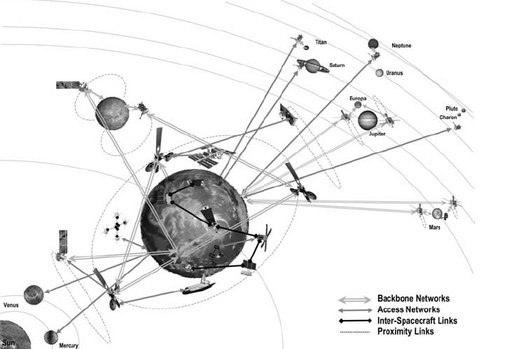
The Interplanetary Internet concept

The Interplanetary Internet concept

In an initiative energized by Google Vice-President and Chief Internet Evangelist Vint Cerf, the International Space Station could be testing a brand new way of communicating with Earth. In 2009, it is hoped that the ISS will play host to an Interplanetary Internet prototype that could standardize communications between Earth and space, possibly replacing point-to-point single use radio systems customized for each individual space mission since the beginning of the Space Age.
Technology Review - Published By MIT

A Better Network for Outer Space

Networking space: Vint Cerf, cocreator of the Internet and a vice president at Google, is designing protocols for a robust space-communication network, modeled on the terrestrial Internet.
clipped from www.youtube.com

Interplanetary Networking/Internet Presentation

blog it
Related:
Google and NASA are Working on an Interplanetary Internet | Universe Today
Technology Review: A Better Network for Outer Space
DSN: About the Deep Space Network
Will the First Mars Settlements have Internet Access? | astroengine.com
Interplanetary Internet - Wikipedia, the free encyclopedia

2008-08-26

Teleconferencing with Telepresence


Rather than traveling great distances, in order to have a face-face meeting, it is now possible to teleconference instead. Telepresence brings people in remote locations together with a life-size, high resolution full motion video and high quality surround audio.

Introduction


Clipped from: Telepresence - Wikipedia, the free encyclopedia

Telepresence refers to a set of technologies which allow a person to feel as if they were present, to give the appearance that they were present, or to have an effect, at a location other than their true location.

Telepresence requires that the senses of the user, or users, are provided with such stimuli as to give the feeling of being in that other location. Additionally, the user(s) may be given the ability to affect the remote location. In this case, the user's position, movements, actions, voice, etc. may be sensed, transmitted and duplicated in the remote location to bring about this effect. Therefore information may be travelling in both directions between the user and the remote location.


Clipped from: Telepresence @ InfoComm - A Review with Howard Lichtman's Thoughts and Analysis - Human Productivity Lab

Telepresence @ InfoComm - A Video Review
A review of most of the telepresence offerings at InfoComm.


Glowpoint


Clipped from: Glowpoint | Telepresence Solutions


Clipped from: YouTube - Glowpoint - Telepresence Managed Services

Glowpoint - Telepresence Managed Services

A video overview of telepresence managed service provider Glowpoint. Glowpoint provides managed network, managed services, and a Telepresence Exchange Network (TEN) for a variety of telepresence systems including solutions from Cisco, Digital Video Enterprises, Polycom, Tandberg, and TelePresence Tech among others.


Cisco


Clipped from: TelePresence - Cisco Systems

Cisco Systems, Inc.

Climate Change and Technology Innovation


Clipped from: YouTube - The Next Step in Global Meetings

Cisco TelePresence. For more information on TelePresence at Cisco and the emerging telepresence industry please visit: www.HumanProductivityLab.com the Internet's #1 destination for Telepresence News, Research, Analysis, and Consulting.


Nortel


Clipped from: Nortel: Services: Telepresence Services: Overview

Nortel


Clipped from: YouTube - Nortel Telepresence commercial

Imagine meeting your colleagues in San Francisco, London, Mexico City and Osaka without traveling to any of these locations. You don't have to imagine it, it's here. Telepresence brings people in remote locations together with a life-size, full motion cinematic view along with extraordinary StereoSurroundTM audio with high resolution content.


Related:

Telepresence - Wikipedia, the free encyclopedia
Telepresence Options - Telepresence News and Analysis
Telepresence @ InfoComm - A Review with Howard Lichtman's Thoughts and Analysis - Human Productivity Lab
Glowpoint | Telepresence Solutions
TelePresence - Cisco Systems
Product Portfolio [TelePresence] - Cisco Systems
Nortel: Services: Telepresence Services: Overview


2008-06-14

Engineering bacteria to be used as biosensors

clipped from www.eurekalert.org

MIT researchers unravel bacteria communication pathways

CAMBRIDGE, Mass. -- MIT researchers have figured out how bacteria ensure that they respond correctly to hundreds of incoming signals from their environment.

The researchers also successfully rewired the cellular communications pathways that control those responses, raising the possibility of engineering bacteria that can serve as biosensors to detect chemical pollutants. The work is reported in the June 13 issue of Cell.

clipped from laublab.mit.edu
the laub lab
clipped from web.mit.edu
MIT Department of Biology

Specificity in signal transduction systems:
Another major focus in the lab is understanding how cells maintain the specificity of signaling systems. Given the highly related nature of the two-component signaling proteins in bacteria, how do cells maintain the insulation of different pathways? What prevents harmful cross-talk? How are signals integrated? We use both computational and experimental approaches to answer these questions.

clipped from laublab.mit.edu
specificity
kinase profile

blog it

Related:
MIT researchers unravel bacteria communication pathways
MIT Department of Biology: Michael Laub
The Laub Lab | Welcome! | Michael Laub | Department of Biology | MIT
The Laub Lab | Welcome! | Michael Laub | Department of Biology | MIT | Research

Zemanta Pixie