Showing posts with label astronomy. Show all posts

2013-03-27

Mini-Supernova Discovered

New Type of Star Explosion Discovered | Type Iax Supernovas | Space.com

Astronomers have discovered a new kind of supernova, a star explosion so weak that scientists dubbed it a miniature stellar blast.

Supernovas represent the deaths of stars, which collapse in powerful explosions. They generally are classified into two main types; the new class, called Type Iax, "is essentially a mini-supernova," said lead researcher Ryan Foley, an astronomer at the Harvard-Smithsonian Center for Astrophysics. "It's the runt of the supernova litter."


This artist's conception shows the suspected progenitor of a new kind of mini supernova called Type Iax. Material from a hot, blue helium star at right is funneling toward a carbon/oxygen white dwarf star at left, which is embedded in an accretion disk. In many cases the white dwarf survives the subsequent explosion. Image released March 26, 2013. CREDIT: Christine Pulliam (CfA)

2012-10-06

Comet ISON Celestial Show in November 2013


BIG SUN-DIVING COMET DISCOVERED: Astronomy forums are buzzing with speculation about newly-discovered Comet C/2012 S1 (ISON). Currently located beyond the orbit of Jupiter, Comet ISON is heading for a very close encounter with the sun next year. In Nov. 2013, it will pass less than 0.012 AU (1.8 million km) from the solar surface. The fierce heating it experiences then could turn the comet into a bright naked-eye object.


THE GREAT COMET OF 1680

The orbital elements of ISON are so surprisingly similar to that of the Comet of 1680 that it has caused speculation in the astronomy community that the two bodies may have once been one comet. [...] This could develop into a “once in a lifetime” opportunity for spectators in the Northern Hemisphere to witness and photograph a truly great comet.


According to a number of articles that appeared at about the same time, the comet's orbit is taking it nearly directly at the Sun, and will get within 1.4 million kilometers of the Sun's surface in November of next year, which should provide a lot of heat to melt the surface and expel gas from the comet. By January, it will be about 60 million kilometers from Earth.

New comet might blaze brighter than the full Moon

Comet brightness predictions sometimes exceed their performance. Amateur astronomers of a certain age may remember the Comet Kohoutek hype of 1973 – not quite the 'damp squib' it has been portrayed, since it reached naked eye visibility! Even if C/2012 S1 takes on the same light curve as Kohoutek it is certain to be spectacular, quite possibly a once-in-a-civilisation's-lifetime event.


2012-05-30

Images of Stars Orbiting a Supermassive Black Hole

The Galactic Center Revisited (Gallery Explorer) - NASA Spitzer Space Telescope

Hiding behind the constellations Sagittarius and Scorpius is the center of our own Milky Way galaxy, over 25,000 light years away. This patch of sky is mostly dark in visible light, shrouded by dust clouds that lie between us and the Galactic center. But the infrared vision of NASA’s Spitzer Space Telescope sees through the dust showing us this strange and tumultuous region.


APOD: 2009 July 27 - NGC 1097: Spiral Galaxy with a Central Eye

What's happening at the center of spiral galaxy NGC 1097? No one is sure, but it likely involves a supermassive black hole. Matter falling in from a bar of stars and gas across the center is likely being heated by an extremely energetic region surrounding the central black hole. [...]

Supermassive black hole - Wikipedia, the free encyclopedia

A supermassive black hole is the largest type of black hole in a galaxy, on the order of hundreds of thousands to billions of solar masses. Most, and possibly all galaxies, including the Milky Way[2] (see Sagittarius A*), are believed to contain supermassive black holes at their centers.[3][4]

Image of the Day: Spectacular Ring of Stars Orbit a Monster Black Hole

The Daily Galaxy via NASA/Hubble Space Telescope and Spitzer
The image above of the central 5,500 light-years wide region of NGC 1097. More than 300 star forming regions - white spots in the image - are distributed along a ring of dust and gas. At the center is a bright central source where the active galactic nucleus and its super-massive black hole are located. About 40 thousand light-years from the larger galaxy's center, the gravity of the companion galaxy appears to be reshaping the larger galaxy as it is slowly being destroyed itself.

ESO - eso0534 - Feeding the Monster

Near-infrared images of the active galaxy NGC 1097, obtained with the NACO adaptive optics instrument on ESO's Very Large Telescope, disclose with unprecedented detail a complex central network of filamentary structure spiralling down to the centre of the galaxy. These observations provide astronomers with new insights on how super-massive black holes lurking inside galaxies get fed.


Colour-composite image of the central 5,500 light-years wide region of the spiral galaxy NGC 1097, obtained with the NACO adaptive optics on the VLT. More than 300 star forming regions - white spots in the image - are distributed along a ring of dust and gas in the image. At the centre of the ring there is a bright central source where the active galactic nucleus and its super-massive black hole are located. The image was constructed by stacking J- (blue), H- (green), and Ks-band (red) images. North is up and East is to the left. The field of view is 24 x 29 arcsec2, i.e. less than 0.03% the size of the full moon!


2012-05-10

NuSTAR: NASA's Black-Hole Hunter

NuSTAR NASA Black Hole Hunter with X-RAY Eyes - YouTube

A large number of galaxies are hiding black holes that we can't detect, and NASA's NuSTAR will use X-ray vision to find them.


Missions - NuSTAR - NASA Science

The Nuclear Spectroscopic Telescope Array is an Explorer mission that will allow astronomers to study the universe in high energy X-rays. Launching in 2012, NuSTAR will be the first focusing hard X-ray telescope to orbit Earth and is expected to greatly exceed the performance of the largest ground-based observatories that have observed this region of the electromagnetic spectrum. NuSTAR will also complement astrophysics missions that explore the cosmos in other regions of the spectrum.
X-ray telescopes such as Chandra and XMM-Newton have observed the X-ray universe at low X-ray energy levels. By focusing higher energy X-rays, NuSTAR will start to answer several fundamental questions about the Universe including:
  • How are black holes distributed through the cosmos?
  • How were heavy elements forged in the explosions of massive stars?
  • What powers the most extreme active galaxies?


NASA's newest X-ray telescope will have a lengthy structure that unfolds in space, allowing it to see high-energy objects like feeding black holes. To view the video of mast deployment in space animation please click here.


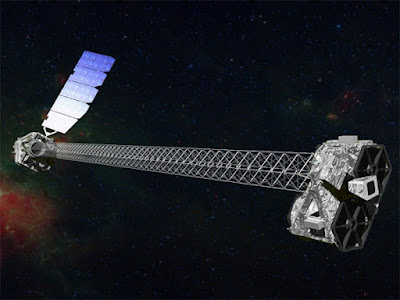
Artist's concept of NuSTAR on orbit. NuSTAR has a 10-m (30') mast that deploys after launch to separate the optics modules (right) from the detectors in the focal plane (left). The spacecraft, which controls NuSTAR's pointings, and the solar panels are with the focal plane. NuSTAR has two identical optics modules in order to increase sensitivity. The background is an image of the Galactic center obtained with the Chandra X-ray Observatory. Image credit: NASA/JPL-Caltech

2012-03-17

Alien Photosynthesis

Far-Out Photosynthesis

Photosynthesis maintains Earth's habitability for life as we know it, and shapes the way we search for habitable worlds around distant stars. Scientists have discovered a microbe that can use low-energy light to perform photosynthesis. This discovery could alter theories about the types of stars that could support Earth-like worlds.

In the process of photosynthesis on Earth, plants convert energy from the sun into chemical energy in the form of glucose, or sugar. The chlorophyll in plants absorbs more blue and red light from sunlight, and less green light. Chlorophyll is green, because it reflects green light more than blue and red light. Credit: NASA Ames


Different types of stars have different temperatures and lifetimes. Cooler red M-class stars live a long time, while hotter blue A-class stars have relatively brief lives. These four pictures are actually four different views of our own star, the sun. Each false-color view highlights atomic emission in different temperature regimes of the upper solar atmosphere. Yellow is 2 million Kelvin, green is 1.5 million K, blue is 1 million K, and red is 60 to 80 thousand K. Image Credit: Stereo Project/NASA

NASA GISS: Research Features: Far-Out Photosynthesis

Kiang emphasizes the implications that the findings could have in the search for life on extrasolar planets - and the future of life here on Earth:

1) "Planets orbiting red dwarf stars may not get much visible light, but they'll get a lot of NIR light. So, now we know it would still make sense to look for oxygenic photosynthesis on such planets, and we could look for pigment signatures in the NIR."

2) "A. marina appears to be a late evolution, occupying a light niche that is produced by leftover photons from Chl a organisms. Since it can use more solar radiation than Chl a organisms, might our planet evolve to have Chl d outcompete Chl a?"

3) "Biomimicry of photosynthesis continues to be a quest in the development of renewable energy, but no one has yet developed an artificial system as good as Nature to split water. For renewable energy that depends on sunlight, do the lower energy photons used with Chl d mean that we don't need such strong artificial catalysts for producing hydrogen fuel and biofuels?"

The findings could completely change our understanding of a biological reaction that is essential to the modern biosphere of Earth. They may also open new doors for the future of humankind in areas like renewable energy. But for NASA, the study could also have implications for the future of life on Earth — and beyond — that are truly far out.


2012-03-08

Black Hole Simulations

Black hole - Wikipedia, the free encyclopedia

A black hole is a region of spacetime from which nothing, not even light, can escape.[1] The theory of general relativity predicts that a sufficiently compact mass will deform spacetime to form a black hole. Around a black hole there is a mathematically defined surface called an event horizon that marks the point of no return. It is called "black" because it absorbs all the light that hits the horizon, reflecting nothing, just like a perfect black body in thermodynamics.[2] Quantum mechanics predicts that black holes emit radiation like a black body with a finite temperature. This temperature is inversely proportional to the mass of the black hole, making it difficult to observe this radiation for black holes of stellar mass or greater.

Simulated view of a black hole (center) in front of the Large Magellanic Cloud. Note the gravitational lensing effect, which produces two enlarged but highly distorted views of the Cloud. Across the top, the Milky Way disk appears distorted into an arc.
Simulation of gravitational lensing by a black hole, which distorts the image of a galaxy in the background


Inside Black Holes


This is not an artist's impression.
It is a general relativistic volume-rendering
of a super-computed simulation.


  • Journey into the simplest kind of black hole, a black hole with mass, but no charge and no spin — a Schwarzschild black hole.
  • Journey into and through a charged black hole — a Reissner-Nordström black hole. This one has a wormhole and a white hole connecting to a new universe.
  • How to understand black holes — a black hole is a waterfall of space.
  • How does a scene appear when you pass through it at near the speed of light? — The rules of 4-dimensional perspective.
  • How to find your way inside black holes — Penrose diagrams.
  • Journey into a realistic (well, kind of) black hole — the wormhole is destroyed by the mass inflation instability.
  • The movies on this site were made with the Black Hole Flight Simulator.


2011-08-22

Redirecting Asteroid Apophis From its Collision Course with Earth

Apophis 99942: The Killer Asteroid of 2036 - YouTube
http://www.youtube.com/watch?v=zazuzkO9nNk

 
This is a short clip of scenes which depict scenarios of the happenings that might take place on April 13, 2036. The asteroid will come very close to the Earth in 2029, but miss. That close encounter will trigger a collision in 2036
Asteroid Apophis 2036 The Official Asteroid Apophis site. Near Earth Asteroid and news.
http://asteroidapophis.com
  • Asteroid Apophis is a possible Earth bound asteroid. Known as 99942 Apophis is a near-Earth asteroid that had caused concern in December 2004 because initial observations indicated a small probability (up to 2.7%) that it would strike the Earth in 2029. Recent news indicate that it could be on a collision course afterall.
  • Apophis will come within 18,000 miles from earth on Friday, April 13th, 2036. That amount of miles is actually very, very close and it will be visible to the naked eye. You thought Halley’s comet was the talk of the world in the 1980’s…just wait until this Asteroid Apophis comes knocking on our door.

     Asteroid Apophis is 1,000 feet in diameter, which is about 90 stories tall and weighs 25 million tons. If this asteroid hits anywhere on earth it would be 68,000 times the force that the atomic bomb that destroyed Hiroshima.

     NASA labeled Apophis as a Near Earth Object. Lets just hope it stays in that label and not become an impact asteroid.
Scientists Are Testing Methods to Deflect the Apophis Asteroid | Video | TheBlaze.com
http://www.theblaze.com/stories/1600-foot-wide-asteroid-headed-for-earth-in-2036-can-scientists-stop-it
  • The European Space Agency will test its technique against a real asteroid in 2015 in a mission called Don Quijote. Don Quijote involves two spacecrafts. One, called Hidalgo, will impact the asteroid at a speed of six miles per second while the other (Sancho) will orbit the asteroid before and after collision collecting data and analyzing just how far off course the impactor spacecraft threw the asteroid.

    Watch the European Space Agency’s simulation here:

  • Similarly, the Chinese researchers propose hitting the asteroid with a spacecraft, but the method of getting there is a bit different. They propose using a solar sail (a form of spacecraft propulsion) to send the spacecraft into retrograde orbit and on a collision course with the asteroid.


  • Shengping Gong and pals at Tsinghua University in Beijing say they've come up with a plan that will ensure Apophis never returns to Earth on this timescale .

     They point out that keyholes are tiny, in this case just 600 metres wide. So deflecting Apophis by only a small amount in the near future will ensure it misses the keyhole and so cannot return to Earth.

     There are various ways to deflect an asteroid. Gong and pals say their preference is to use a solar sail to place a small spacecraft into a retrograde orbit and on collision course with Apophis. The retrograde orbit will give it an impact velocity of 90km/s which, if they do this well enough in advance, should lead to a collision large enough to do the trick.

     Putting a spacecraft into a retrograde orbit about the Sun using little or no fuel is a pretty neat trick by anyone's standards.. The Chinese team's calculations demonstrate the point. They show that a 10 kg sail in retrograde orbit, that hits Apophis a year before 2029, would deflect it enough to miss the keyhole, thereby eliminating the chance that the asteroid will return in 2036.
European Space Agency plan to blow up an asteroid 'hurtling towards Earth' | Mail Online
http://www.dailymail.co.uk/sciencetech/article-2026710/European-Space-Agency-plan-blow-asteroid-hurtling-Earth.html
  • Rescue plan: The European Space Agency is planning mission Don Quijote - to blow up a huge asteroid that could potentially be hurtling towards Earth
  • In the Hollywood movie Armageddon, Bruce Willis attempts to blow up a huge asteroid hurtling towards Earth.
     In real life, the mission, called Don Quixote, will see two spacecraft launched.
  • One will be fired at an asteroid  at  break-neck speed in an attempt to push it off its course. The other will analyse data with the aim  of informing future missions in which the  future of mankind may be at stake.


2011-03-06

Evidence of Alien Life on Meteorite


NASA Offers Proof Of Alien Life | Spaceosaur


A NASA scientist has come to the surprising conclusion that alien life exists, and even has the fossils of it to back the claims up.

The alleged fossil shown in the picture above was found in a meteorite by Dr. Richard B. Hoover, an astrobiologist with NASA’s Marshall Space Flight Center, cracked open the meteorite in a totally sterile lab, and using an electron microscope took the image above, which certainly does look like bacteria. In fact, Dr Hoover noted that it looked surprisingly similar to the giant bacterium Titanospirillum velox, an organism found here on planet Earth.

Fox News - Fair & Balanced

Exclusive: NASA Scientist Claims Evidence of Alien Life on Meteorite - FoxNews.com


Riccardo Guerrero / Richard B. Hoover / Journal of Cosmology

A photograph taken through a scanning electron microscope of a CI1 meteorite (right) is similar in size and overall structure to the giant bacterium Titanospirillum velox (left), an organism found here on planet Earth, a NASA scientist said.

In what he calls “a very simple process,” Dr. Hoover fractured the meteorite stones under a sterile environment before examining the freshly broken surface with the standard tools of the scientist: a scanning-electron microscope and a field emission electron-scanning microscope, which allowed him to search the stone’s surface for evidence of fossilized remains.

He found the fossilized remains of micro-organisms not so different from ordinary ones found underfoot -- here on earth, that is.

“The exciting thing is that they are in many cases recognizable and can be associated very closely with the generic species here on earth,” Hoover told FoxNews.com. But not all of them. “There are some that are just very strange and don’t look like anything that I’ve been able to identify, and I’ve shown them to many other experts that have also come up stumped.”

Astrobiology - Wikipedia, the free encyclopedia

Astrobiology (or exobiology) is the study of the origin, evolution, distribution, and future of life in the universe, besides Earth. This interdisciplinary field encompasses the search for habitable environments in our Solar System and habitable planets outside our Solar System, the search for evidence of prebiotic chemistry, laboratory and field research into the origins and early evolution of life on Earth, and studies of the potential for life to adapt to challenges on Earth and in outer space.[2]

[...]

As of 2010, no proof of extraterrestrial life has been identified. Examination of the ALH 84001 meteorite, which was recovered in Antarctica in 1984 and believed to have originated from Mars, is thought by David McKay, Chief Scientist for Astrobiology at NASA's Johnson Space Center, as well as other scientists, to contain microfossils of extraterrestrial origin; this interpretation is controversial.[63][64][65][66] More recently, on March 5, 2011, Richard B. Hoover, an astrobiologist with the Marshall Space Flight Center, speculates on the finding of alleged microfossils similar to cyanobacteria in CI1 carbonaceous meteorites.[67][68]


Journal of Cosmology, 2011, Vol 13,
JournalofCosmology.com March, 2011

Fossils of Cyanobacteria in CI1 Carbonaceous Meteorites
Richard B. Hoover, Ph.D. NASA/Marshall Space Flight Cente


[...]


Official Statement from Dr. Rudy Schild,
Center for Astrophysics, Harvard-Smithsonian,
Editor-in-Chief, Journal of Cosmology.

Dr. Richard Hoover is a highly respected scientist and astrobiologist with a prestigious record of accomplishment at NASA. Given the controversial nature of his discovery, we have invited 100 experts and have issued a general invitation to over 5000 scientists from the scientific community to review the paper and to offer their critical analysis. Our intention is to publish the commentaries, both pro and con, alongside Dr. Hoover's paper. In this way, the paper will have received a thorough vetting, and all points of view can be presented. No other paper in the history of science has undergone such a thorough analysis, and no other scientific journal in the history of science has made such a profoundly important paper available to the scientific community, for comment, before it is published. We believe the best way to advance science, is to promote debate and discussion.
Collected from: Journal of Cosmology

2010-11-27

Before the Big Bang -- Roger Penrose's Conformal Cyclic Cosmology

"We Can Glimpse the Universe Before the Big Bang": One of World's Leading Physicists


The circular patterns within the cosmic microwave background suggest that space and time did not come into being at the Big Bang but that our universe in fact continually cycles through a series of "aeons," according to University of Oxford theoretical physicist Roger Penrose, who says that data collected by NASA's WMAP satellite supports his idea of "conformal cyclic cosmology".


Black hole encounters would have repeated themselves several times, with the center of each event remaining at almost exactly the same point in the CMB sky, even when occurring in different aeons. The huge amounts of energy released would appear as spherical, low-variance radiation bursts in the CMB. Image credit: Gurzadyan and Penrose.


Penrose claims to have glimpsed universe before Big Bang - physicsworld.com


Seeing through the Big Bang

According to Penrose and Gurzadyan, these circles allow us to "see through" the Big Bang into the aeon that would have existed beforehand. The circles, they say, are the marks left in our aeon by the spherical ripples of gravitational waves that were generated when black holes collided in the previous aeon. And they say that these circles pose a problem for inflationary theory because this theory says that the distribution of temperature variations across the sky should be Gaussian, or random, rather than having discernable structures within it.

arXiv.org > astro-ph > arXiv:1011.3706

Concentric circles in WMAP data may provide evidence of violent pre-Big-Bang activity


2010-11-05

Space Buckyballs


NASA's Spitzer Space Telescope has at last found buckyballs in space, as illustrated by this artist's conception showing the carbon balls coming out from the type of object where they were discovered -- a dying star and the material it sheds, known as a planetary nebula.
Collected from: NASA - Space Balls


Discovery News

Bushels of Buckyballs Found in Space


Strong cages of carbon, known as buckyballs, have been found not only in the exploded remains of stars, but also in interstellar space, raising the prospect that they may be the packaging to transport other molecules and atoms through the galaxy.

THE GIST
  • Astronomers find buckyballs, hollow spheres of carbon, in four planetary nebulae and in interstellar space.
  • Buckyballs can travel between the stars, possibly transporting atoms and small molecules.
  • Meteorites that crashed into Earth have been found with buckyballs holding gases from beyond the solar system.

NASA - Space Buckyballs Thrive, Finds NASA Spitzer Telescope


"It turns out that buckyballs are much more common and abundant in the universe than initially thought," said astronomer Letizia Stanghellini of the National Optical Astronomy Observatory in Tucson, Ariz. "Spitzer had recently found them in one specific location, but now we see them in other environments. This has implications for the chemistry of life. It's possible that buckyballs from outer space provided seeds for life on Earth."


2010-10-20

Hartley 2 The Green Comet

Here Comes Comet Hartley 2!


Comet 103P/Hartley 2, a small periodic comet, was discovered in 1986 by Malcolm Hartley, an Australian astronomer. It orbits the sun about every 6.5 years, and on Oct. 20, the comet will make its closest approach to Earth since its discovery. In this case, "close" means 11 million miles, or 17.7 million kilometers. A moonless sky will make for promising viewing conditions in the northeastern skies, especially just before dawn.

Comet Hartley 2's nuclear diameter is estimated at 0.75-0.99 of one mile -- 1.2-1.6 kilometers -- and it's believed to have enough mass to make approximately 100 more apparitions, or appearances, near Earth. The 2010 appearance also marks one of the closest approaches of any comet in the last few centuries.


Why is the comet green? Answer: Hartley 2's green color comes from the gases that make up its Jupiter-sized atmosphere. Jets spewing from the comet's nucleus contain cyanogen (CN: a poisonous gas found in many comets) and diatomic carbon (C2). Both substances glow green when illuminated by sunlight in the near-vacuum of space.


103P/Hartley - Wikipedia, the free encyclopedia


2010 approach

The comet will pass within 0.12 AU of the Earth on October 20, 2010,[6] only eight days before coming to perihelion (closest approach to the Sun) on October 28, 2010.[1] During this passage, the comet may be visible to the naked eye at apparent magnitude 5,[7] in the constellation Auriga, near its open clusters, if an observer knows where to look and is viewing from a dark sky location. Binoculars should make it an easy target.


Comet 103P Hartley from as seen from a four inch telescope, October 6th, 2010.
The comet passed near the position of NGC 281 in Cassiopeia on October 1. On the night of October 7 at New Moon, the comet is expected to pass near the Double Cluster in the sky and near the open cluster NGC 1528 by October 14, both in Perseus. In early November the comet will be visible around midnight without interference from the Moon.[8]

Comet 103P passing within 0.12AU of Earth on October 20, 2010.[6]