Showing posts with label Purdue. Show all posts

2009-01-14

A Virus Nanomotor

ScienceDaily: Your source for the latest research news  and science breakthroughs -- updated daily

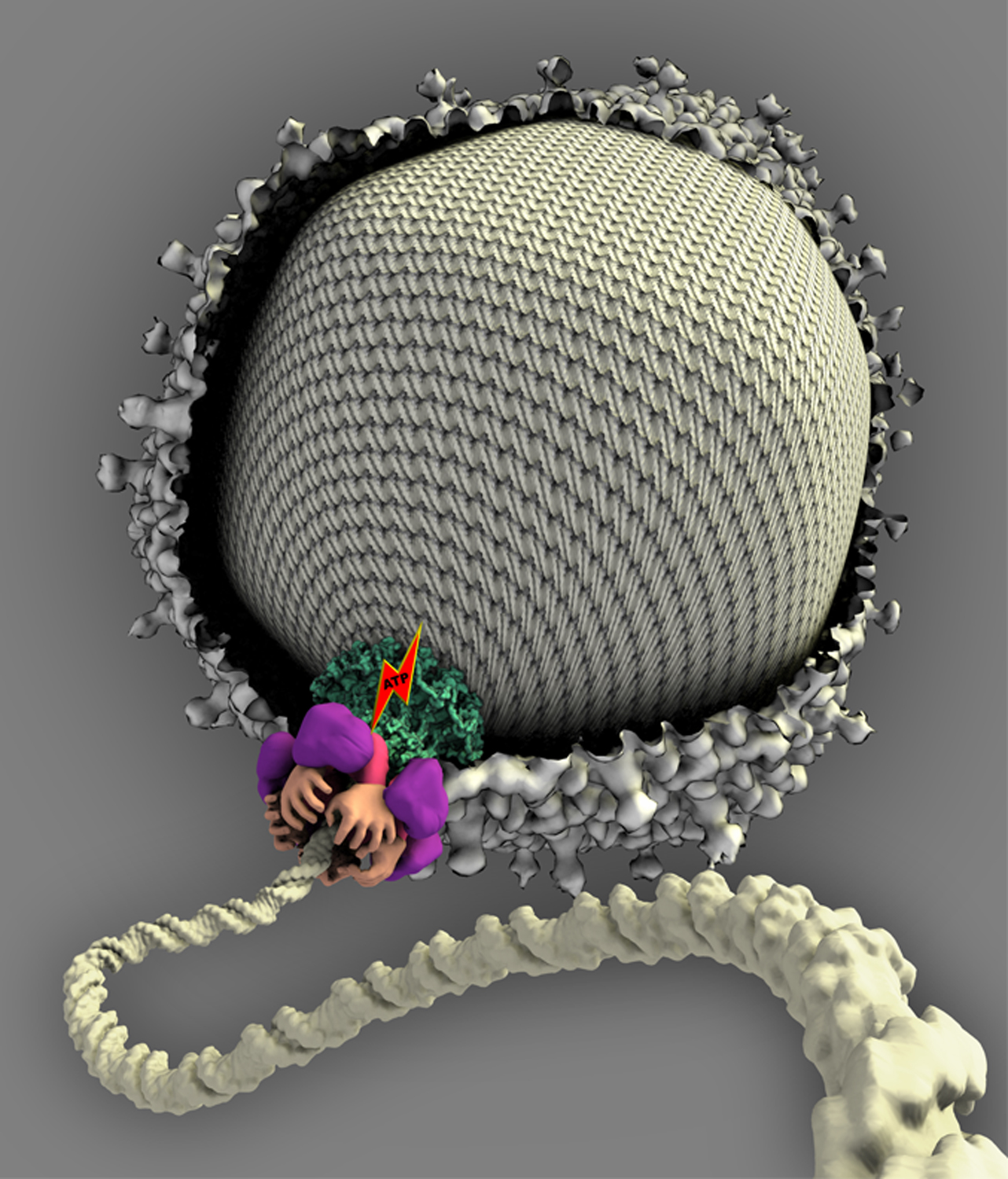
Clockwork That Drives Powerful Virus Nanomotor Discovered

ScienceDaily (Dec. 31, 2008) — Peering at structures only atoms across, researchers have identified the clockwork that drives a powerful virus nanomotor.

clipped from news.uns.purdue.edu

Biologists learn structure, mechanism of powerful 'molecular motor' in virus

clipped from news.uns.purdue.edu
http://news.uns.purdue.edu/images/+2008/RossmannMotors.jpg
clipped from news.uns.purdue.edu

The motor is needed to insert DNA into the capsid of the T4 virus, which is called a bacteriophage because it infects bacteria. The same kind of motor, however, also is likely present in other viruses, including the human herpes virus.

"Molecular motors in double-stranded DNA viruses have never been shown in such detail before," said Siyang Sun, a postdoctoral research associate working in Rossmann's lab.

clipped from bio.purdue.edu
Purdue University

Biological Sciences

MICHAEL ROSSMANN


blog it
clipped from www.nsf.gov
National Science Foundation

Press Release 08-220
Viruses, Start Your Engines!

Researchers find what drives one of nature's powerful, nanoscale motors

Because of the motor's strength--to scale, twice that of an automobile--the new findings could inspire engineers designing sophisticated nanomachines. In addition, because a number of virus types may possess a similar motor, including the virus that causes herpes, the results may also assist pharmaceutical companies developing methods to sabotage virus machinery.

clipped from www.youtube.com

Virus as Nano Motors Part 1 of 3

clipped from www.youtube.com

Virus as Nano Motors Part 2 of 3

clipped from www.youtube.com

Virus as Nano Motors Part 3 of 3


blog it

Related:
Clockwork That Drives Powerful Virus Nanomotor Discovered
Biologists learn structure, mechanism of powerful 'molecular motor' in virus
Department Biological Sciences, Purdue University
nsf.gov - Office of Legislative and Public Affairs (OLPA) News - Viruses, Start Your Engines! - US National Science Foundation (NSF)
Viruses, start your engines!
Biologists learn structure, mechanism of powerful viral 'molecular motor' - R & D
What Drives One Of Nature's Powerful, Nanoscale Motors? - Health - redOrbit

2008-08-12

New technology finds chemicals in fingerprints


Clipped from: Fingerprint Test Tells What a Person Has Touched - NYTimes.com


Fingerprint Test Tells What a Person Has Touched

With a new analytical technique, a fingerprint can now reveal much more than the identity of a person. It can now also identify what the person has been touching: drugs, explosives or poisons, for example.

Clipped from: Fingerprints provide clues to more than just identity


http://news.uns.purdue.edu/images/+2008/cooks-fingerprint.jpg

The research was performed within Purdue's Center for Analytical Instrumentation Development located at the Bindley Biosciences Center in Purdue's Discovery Park.

Cooks' device, called desorption electrospray ionization or DESI, has been commercialized by Indianapolis-based Prosolia Inc., and the research was funded by Office of Naval Research and Prosolia Inc.


Clipped from: Lifesaving Answers Hidden Inside Fingerprints

Purdue University Chemistry professor R. Graham Cooks unveiled a new scientific discovery in Friday’s issue of the journal Science. It appears that human fingerprints can determine more than just who you are. They also contain extremely small traces of what someone touched, what someone ate or whether any drugs were taken.

The researchers used a technique called DESI, pioneered by him and his collaborators in 2004. In this revolutionary method, researchers spray microscopic droplets of water onto a sample. The droplets form a film that dissolves chemicals. Some of the additional droplets splashed bounce back and are sucked into a tube. They are thus heated inside the tube; they break into smaller molecules which are afterwards identified according to their molecular weight.


Clipped from: CAID - Center for Analytical Instrumentation Development


Related:
Fingerprint Test Tells What a Person Has Touched - NYTimes.com
Fingerprints provide clues to more than just identity
Purdue establishes center focused on analytical instrumentation; creates 'dream team' with regional universities
CAID - Center for Analytical Instrumentation Development
Fingerprints provide clues to more than just identity
DESI Gives Fingerprinting Some New Respect | Scientific Blogging
Lifesaving Answers Hidden Inside Fingerprints

2008-03-12

Scientists See Virus in Great Detail

[click image to enlarge]

Image of bacteriophage Epsilon15 studied by Wen Jiang, an assistant professor of biological sciences at Purdue. The bacteriophage is shown at a resolution of 4.5 angstrom - the highest resolution achieved for a living organism of this size. (Graphic/Wen Jiang lab)

A three-dimensional image of a virus at a resolution of 4.5 angstroms

"This is one of the first projects to refine the technique to the point of near atomic-level resolution," said Jiang, who also is a member of Purdue's structural biology group. "This breaks a threshold and allows us to now see a whole new level of detail in the structure. This is the highest resolution ever achieved for a living organism of this size."

Details of the structure of a virus provide valuable information for development of disease treatments, he said.

"If we understand the system - how the virus particles assemble and how they infect a host cell - it will greatly improve our ability to design a treatment," Jiang said. "Structural biologists perform the basic science and provide information to help those working on the clinical aspects."
via: Microscopy Breakthrough: Scientists See Virus in Great Detail - Medgadget - www.medgadget.com
related:
Microscope to give biological sciences group a new look
Purdue breaks ground on Hockmeyer Hall