Showing posts with label neuroscience. Show all posts

2012-10-28

Evidence of Presentiment Without External Clues

Listen to Your Intuition, Because Your Body Can Predict Future Events Without Conscious Clues | Popular Science


Humans can predict the future when we have some evidence--like clouds and the smell of rain hinting at a storm. But can we anticipate future events without sensory clues?

Can your body sense future events without any external clue?

ScienceDaily (Oct. 22, 2012) — Wouldn't it be amazing if our bodies prepared us for future events that could be very important to us, even if there's no clue about what those events will be?
Presentiment without any external clues may, in fact, exist, according to new Northwestern University research that analyzes the results of 26 studies published between 1978 and 2010.
A business person playing a video game during working hours. Wouldn't it be amazing if our bodies prepared us for future events that could be very important to us, even if there's no clue about what those events will be? (Credit: © Vitaly Raduntsev / Fotolia)

Can Your Body Sense Future Events Without Any External Clue?: Northwestern University News

This phenomenon is sometimes called “presentiment,” as in “sensing the future,” but Mossbridge said she and other researchers are not sure whether people are really sensing the future.

“I like to call the phenomenon ‘anomalous anticipatory activity,’” she said. “The phenomenon is anomalous, some scientists argue, because we can’t explain it using present-day understanding about how biology works; though explanations related to recent quantum biological findings could potentially make sense. It’s anticipatory because it seems to predict future physiological changes in response to an important event without any known clues, and it’s an activity because it consists of changes in the cardiopulmonary, skin and nervous systems.”

The study, “Predictive Physiological Anticipation Preceding Seemingly Unpredictable Stimuli: A Meta-Analysis,” is in the current edition of Frontiers in Perception Science. In addition to Mossbridge, co-authors of the study include Patrizio Tressoldi of the UniversitĂ  di Padova, Padova, Italy, and Jessica Utts of the University of California, Irvine.

Visual Perception, Neuroscience, and Cognition Lab Northwestern University

Some more specific research questions our lab focuses on:
  • How do we perceive scenes, space, faces, objects, form, motion and time?
  • How do awareness, intention, and short/long-term experience influence perception and attention? 
  • How does auditory, tactile, and visual information integrate to generate coherent perceptual experience? 
  • What are the neural (EEG) correlates of dynamic perceptual and attentional states? 
  • What mechanisms keep our mind in a balanced (metastable) state, enabling us to generate different perceptual interpretations? 
  • How do people differ in their abilities to control attention?


2012-10-12

Mice can sing and learn new tunes

Singing mice show signs of learning

"We are claiming that mice have limited versions of the brain and behavior traits for vocal learning that are found in humans for learning speech and in birds for learning song," said Duke neurobiologist Erich Jarvis, who oversaw the study. The results appear Oct. 10 in PLOS ONE and are further described in a review article in Brain and Language.

The discovery contradicts scientists' 60-year-old assumption that mice do not have vocal learning traits at all. "If we're not wrong, these findings will be a big boost to scientists studying diseases like autism and anxiety disorders," said Jarvis, who is a Howard Hughes Medical Institute investigator. "The researchers who use mouse models of the vocal communication effects of these diseases will finally know the brain system that controls the mice's vocalizations."

Jarvis acknowledged that the findings are controversial because they contradict scientists' long-held assumption about mice vocalizations. His research suggests the vocal communication pathways in mice brains are more similar to those in human brains than to sound-making circuits in the brains of chimpanzees and other non-human primates. The results also contradict two recent studies suggesting mice do not match pitch or have deafness-induced vocalization changes.

Singing Mice Show Signs of Learning | Duke Today

Male mice may learn to match other males' ultrasonic squeaks to get the girls. Credit: iStock.

In the study, funded by HHMI, NSF and NIH, Arriaga first used gene expression markers, which lit up neurons in the motor cortex of the mice's brain as they sang. Arriaga then damaged these song-specific neurons in the motor cortex and observed that the mice couldn’t keep their songs on pitch or repeat them as consistently, which also happened when the mice became deaf.

This image shows the motor cortex neurons that directly project to the brainstem and ultimately control the larynx of male mice. Credit: Gustavo Arriaga and Erich Jarvis, Duke.

PLOS ONE: Of Mice, Birds, and Men: The Mouse Ultrasonic Song System Has Some Features Similar to Humans and Song-Learning Birds

Figure 1. Brain systems for vocalization in birds and mammals.

A, Typical ultrasonic song segment (sonogram) of a male B6D2F1/J (BxD) mouse produced in response to presentation of female urine. Multiple distinct syllables (letters) are produced in long sequences (sometimes over 30 sec), but only 1 second is shown so that the frequency contours and nonlinearities of individual units can be resolved. The sonogram was generated from Audio S1.
Audio S1.
Example of a normal adult BxD mouse song (audio corresponds to sonogram of USVs in Figure 1A ).
(WAV)

Duke Institute for Brain Sciences - Jarvis, Erich - Ph.D. | Duke Institute for Brain Sciences | Brain Research

Erich Jarvis, Ph.D.

Associate Professor; Howard Hughes Medical Institute Investigator
Neurobiology, School of Medicine
DIBS Faculty

Research Description

Our goal is to understanding the molecular mechanisms that construct, modify, and maintain neural circuits for vocal learning. Vocal learning is the ability to modify or imitate the acoustic structure and sequence of vocalizations and is a critical behavioral substrate for spoken language. Studying these mechanisms requires that we compare the genes, vocal behavior, and associated brain pathways of the few rare groups that have vocal learning with the vast majority of species that do not. [...]


2012-09-05

Amazing Memory

THE BRAIN FROM TOP TO BOTTOM

SHORT-TERM MEMORY

In the course of a day, there are many times when you need to keep some piece of information in your head for just a few seconds. Maybe it is a number that you are “carrying over” to do a subtraction, or a persuasive argument that you are going to make as soon as the other person finishes talking. Either way, you are using your short-term memory.

[...]

This ability to hold on to a piece of information temporarily in order to complete a task is specifically human. It causes certain regions of the brain to become very active, in particular the pre-frontal lobe.


LONG-TERM MEMORY

Information is transferred from short-term memory (also known as working memory) to long-term memory through the hippocampus, so named because its shape resembles the curved tail of a seahorse (hippokampos in Greek). The hippocampus is a very old part of the cortex, evolutionarily, and is located in the inner fold of the temporal lobe.


Hyperthymesia - Wikipedia, the free encyclopedia

Hyperthymesia, also known as piking[1] or hyperthymestic syndrome[2] is a condition in which an individual possesses a superior autobiographical memory, meaning he or she can recall the vast majority of personal experiences and events in his or her life. The term “hyperthymesia" is derived from the Greek words "thymesis," meaning "remembering," and "hyper," meaning "excessive."

Amazing Memory | Innovations

At last count, at least 33 people in the world could tell you what they ate for breakfast, lunch and dinner, on February 20, 1998. Or who they talked to on October 28, 1986. Pick any date and they can pull from their memory the most prosaic details of that thin slice of their personal history.

Others, no doubt, have this remarkable ability, but so far only those 33 have been confirmed by scientific research. The most famous is probably actress Marilu Henner, who showed off her stunning recall of autobiographical minutiae on “60 Minutes” a few years ago.

What makes this condition, known as hyperthymesia, so fascinating is that it’s so selective. These are not savants who can rattle off long strings of numbers, Rainman-style, or effortlessly retrieve tidbits from a deep vault of historical facts. In fact, they generally perform no better on standard memory tests than the rest of us.


Unforgettable - The Documentary

UNFORGETTABLE tells the fascinating story of BRAD WILLIAMS. Featured on 60 Minutes and dubbed "the Human Google" by Good Morning America, Brad is only the second person ever studied for HYPERTHYMESIA (also known as superior autobiographical memory), an uncanny and detailed recall of his entire life.


Marilu Henner Has Hyperthymesia, Highly Superior Autobiographical Memory, Can Recall Every Day Of Her Life

Do you remember what happened on June 3rd, 1986? How about April 19th, 1994? If you’re Marilu Henner you do. The actress is one of 12 people in the world who has been diagnosed with hyperthymesia, which is also known as Highly Superior Autobiographical Memory. Basically, Henner can recall every single day of her life.

2012-04-28

Synesthesia, Savant Syndrome: Jason Padgett, A Real ‘Beautiful Mind'

Brain-damaged college dropout became maths genius after attack | Mail Online

A college dropout has been hailed a unique maths genius - after his brain was damaged in a brutal attack by muggers.

Jason Padgett, 41, was left concussed after he was ambushed outside a karaoke club and repeatedly kicked in the head.

Now, wherever he looks, he sees mathematical formulas and turns them into stunning, intricate diagrams he can draw by hand.

He is the only person in the world known to have the skill and experts say it was caused by his head injury.

Real ‘Beautiful Mind’: College Dropout Became Mathematical Genius After Mugging (PHOTOS) - ABC News


“I see bits and pieces of the Pythagorean theorem everywhere,” he said. “Every single little curve, every single spiral, every tree is part of that equation.”
The diagrams he draws are called fractals and Padgett can draw a visual representation of the formula Pi, that infinite number that begins with 3.14.

Jason Padgett's drawing of Pi.

A scan of Padgett’s brain showed damage that was forcing his brain to overcompensate in certain areas that most people don’t have access to, Brogaard explained. The result was Padgett was now an acquired savant, meaning brilliant in a specific area.

“Savant syndrome is the development of a particular skill, that can be mathematical, spatial, or autistic, that develop to an extreme degree that sort of makes a person super human,” Brogaard said.


Synesthesia, Savant Syndrome, Jason Padgett, Beautiful mind 314, Island of genius - YouTube


This is a hand drawn fractal. Jason Padgett, a mathematician with synesthesia (a condition where the brain interprets numbers as shapes) draws a fractal of space time at the Planck Particle size frame and at a certain frequency. Then wave equations (uncertainty) make the drawing warp and stretch as space time does from the Heisenburg Uncertainty Principle.

2012-02-20

Brain Boosting with Transcranial Direct Current Stimulation (TDCS)

£500 electric shock machine can boost learning and memory - but scientists worry it could be misused | Mail Online

Researchers have found brain stimulation via small electric shocks can boost memory and learning

A machine which stimulates your brain with tiny electric shocks can improve memory, problem-solving and mathematical abilities, psychologists have found.

[...]

Dr Roi Cohen Kadosh, a neuroscientist, uses a high-tech system called transcranial direct current stimulation (tDCS) to stimulate precise regions of the brain with a tiny buzz of electric current.

When he stimulates the parietal lobes, which are responsible for our skills in reading, writing and numeracy, he can boost mathematical skills.

The electric current triggers the area to produce chemicals that cause brain cells to develop or change. This process — ‘neural plasticity’ — is essential to learning (our brains change structure when we take on new information).

Why Cognitive Enhancement Is in Your Future (and Your Past) - Ross Andersen - Technology - The Atlantic


Let's look at the nature of the new technology. Last week a team of ethicists from Oxford released a paper on the implications of using Transcranial Direct Current Stimulation (TDCS) to improve cognition in human beings.  Recent years have seen some encouraging, if preliminary, lab results involving TDCS, a deep brain stimulation technique that uses electrodes placed outside the head to direct tiny painless currents across the brain. The currents are thought to increase neuroplasticity, making it easier for neurons to fire and form the connections that enable learning. There are signs that the technology could improve language acumen, math ability, and even memory. The Oxford paper argues that TDCS has now reached a critical stage where its risks must be carefully considered before the research goes further.

The ethics of brain boosting

Julian says: "At this stage, we need more research to understand better the risks and benefits, in specific populations, in real life. Any regulation should prevent misuse and abuse, but facilitate good research. This kind of technology could be as important as the internet and computing. Those are external cognitive enhancements. This is basic fundamental cognitive enhancement."


2012-01-02

Multitasking with Multifocal Attention

The Multi-task evolution

We twitch from cellphone to email, Facebook to Twitter, flat screen television to treadmill, laptop to tablet, with an eye on the stove and the kids.

So what's the breaking point when our bodies, our minds, or both, say enough?

Scientists such as Julio Martinez-Trujillo, Canada Research Chair in neuroscience at McGill University, believe we are hard-wired to multi-task. "Imagine having to pay attention to several predators all around you in the savannah."
[...]
What of the children of the digital age?

"Imagine a student today. They've got an iPod, they've got an iPad, maybe the television is on." Fail to learn to do several things at once, and "life is going to be hard."

Martinez-Trujillo believes the kids will be all right.

"There are two schools of thought on multi-tasking. Some people have argued that the next generation are going to all have ADHD, that they will be incapable of focusing," he said. "I'm not seeing that. The students in my classes don't seem to be suffering, their grades aren't going down. They are adapting."
[...]
For nearly 30 years, the widelyaccepted view on multi-tasking held
that there was a single "spotlight" that controlled attention within the prefrontal cortex, the executive section of our brain just above the forehead which serves as the mind's organizer.

News: How do we split our attention?


McGill's Cognitive Neurophysiology Lab team finds that we are natural-born multi-taskers

Imagine you're a hockey goalie, and two opposing players are breaking in alone on you, passing the puck back and forth. You're aware of the linesman skating in on your left, but pay him no mind. Your focus is on the puck and the two approaching players. As the action unfolds, how is your brain processing this intense moment of "multi-tasking"? Are you splitting your focus of attention into multiple "spotlights?" Are you using one "spotlight" and switching between objects very quickly? Or are you "zooming out" the spotlight and taking it all in at once?

These are the questions Julio Martinez-Trujillo, a cognitive neurophysiology specialist from McGill University, and his team set out to answer in a new study on multifocal attention. They found that, for the first time, there's evidence that we can pay attention to more than one thing at a time.


Cognitive Neurophysiology Laboratory - Dr. Martinez-Trujillo


Dr. Julio Martinez-Trujillo Lab
The laboratory uses a combination of techniques such as behavioral measurements, extra-cellular single cell recordings and brain mapping in order to explore the physiology of cognition, more specifically, the physiology of attention, visuomotor transformations and motion perception. Ultimately, the results of our research will be applied to the study of diseases that affect human health.


2011-12-25

Your Brain on Ads -- Neuromarketing fMRI

Neuromarketing - Wikipedia, the free encyclopedia

Neuromarketing is a new field of marketing that studies consumers' sensorimotor, cognitive, and affective response to marketing stimuli. Researchers use technologies such as functional magnetic resonance imaging (fMRI) to measure changes in activity in parts of the brain, electroencephalography (EEG) and Steady state topography (SST) to measure activity in specific regional spectra of the brain response, and/or sensors to measure changes in one's physiological state (heart rate, respiratory rate, galvanic skin response) to learn why consumers make the decisions they do, and what part of the brain is telling them to do it.

[...]

The neuromarketing concept was developed by psychologists at Harvard University in 1990. The technology is based on a model whereby the major thinking part of human activity (over 90%) including emotion proceeds in subconscious area that is below the levels of controlled awareness. For this reason the perception technologists of the market are very tempted to learn the techniques of effective manipulation of the subconscious brain activity. The main reason is to inspire the desired reaction in person’s perception as deeply as possible.


Home - BrainImpact

95% of consumers purchasing
behaviours are guided by unconscious
buying process

Euronews-science, september 2011 - Tv report


Neuromarketing - Ads That Whisper to the Brain - NYTimes.com

WHAT happens in our brains when we watch a compelling TV commercial?

For one thing, certain brain waves that correlate with heightened attention become more active, according to researchers who have used EEGs, or electroencephalographs, to study the brain’s electrical frequencies. Brain waves that signal less-focused attention, meanwhile, tend to subside.

[...]

If pitches are to succeed, they need to reach the subconscious level of the brain, the place where consumers develop initial interest in products, inclinations to buy them and brand loyalty, says A. K. Pradeep, the founder and chief executive of NeuroFocus, a neuromarketing firm based in Berkeley, Calif.

[...]

A handful of neuromarketing firms, like EmSense, Sands Research, MindLab International and NeuroSense, now specialize in the latest mind-mining techniques — EEGs, M.R.I.’s, eye-tracking — or in older biometric methods that track skin, muscle or facial responses to products or ads.

2011-12-10

Automated Learning by Decoded fMRI Neurofeedback

Learning skills like characters on The Matrix set to become a reality, say scientists | Mail Online


Scientists at Boston University and ATR Computational Neuroscience Laboratories in Kyoto, Japan, believe that in the future learning a new skill might involve nothing more than sitting in front of a computer screen and waiting for it to ‘upload’.

They have been studying how a functional magnetic resonance machine (FMRI) can ‘induce’ knowledge in someone through their visual cortex by sending signals that change their brain activity pattern.


This process is called Decoded Neurofeedback, or ‘DecNef’.


nsf.gov - National Science Foundation (NSF) News - Vision Scientists Demonstrate Innovative Learning Method - US National Science Foundation (NSF)


The result, say researchers, is a novel learning approach sufficient to cause long-lasting improvement in tasks that require visual performance.

What's more, the approached worked even when test subjects were not aware of what they were learning.

[...]
The finding brings up an inevitable question. Is hypnosis or a type of automated learning a potential outcome of the research?

[...]

At present, the decoded neurofeedback method might be used for various types of learning, including memory, motor and rehabilitation.


2011-03-23

NeuroFocus' Mynd™, World's First Portable Brain Scanner

Advertising analytics next frontier: Monitoring your subconscious - SmartPlanet


A gadget is aiming to monitor consumers’ “deep subconscious responses” and brainwaves to gauge the reaction to advertising and other media content.

[...]

Dr. A. K. Pradeep, CEO of NeuroFocus, said Mynd can enable “neuromarketing” to gain “critical knowledge and insights into how consumers perceive their brands, products, packaging, in-store marketing, and advertising at the deep subconscious level in real time.”

For advertisers, Mynd holds the Holy Grail—knowing what consumers really think about your marketing instead of just what they tell you. In theory, consumers could wear Mynd at theaters, the home, malls and auditoriums. The data could be streamed to smartphones and tablets.

NeuroFocus Announces World's First Wireless Full-Brain EEG Measurement Headset: Mynd™ -- NEW YORK, March 21, 2011 /PRNewswire/ --

NEW YORK, March 21, 2011 /PRNewswire/ -- NeuroFocus unveiled the first dry, wireless headset designed to capture brainwave activity across the full brain today at the 75th Annual Advertising Research Foundation conference being held at the Marriott Marquis in New York.  Developed over the last three years, Mynd™ combines medical-grade technology with mobility, leapfrogging current neurological testing methods.  For the first time, market researchers will be able to capture the highest quality data on consumers' deep subconscious responses in real time wirelessly, revolutionizing mobile in-store market research and media consumption at home.


MediaPost Publications Nielsen-Backed NeuroFocus Unveils Breakthrough Brain Measuring Technology, Critics Say Nevermynd 03/21/2011

[...]
Dr. A.K. Pradeep, the founder and CEO of NeuroFocus told MediaDailyNews that the Mynd represents a breakthrough, not just because of its lightweight nature, and the fact that it utilizes a "dry electrode" method that doesn't require people to put wet gels on their heads to be tested, but because it can read their brain signals with a level of fidelity that was not previously
possible.

[...]

Because the Mynd device also includes wireless Bluetooth technology enabling it to sync with various Bluetooth enabled devices such as smartphones, tablets, computers and gaming systems, Dr. Pradeep says it will enable media researchers to understand aspects of consumer behavior never before possible.

Neuromarketing - Wikipedia, the free encyclopedia

Neuromarketing is a new field of marketing that studies consumers' sensorimotor, cognitive, and affective response to marketing stimuli. Researchers use technologies such as functional magnetic resonance imaging (fMRI) to measure changes in activity in parts of the brain, electroencephalography (EEG) to measure activity in specific regional spectra of the brain response, and/or sensors to measure changes in one's physiological state (heart rate, respiratory rate, galvanic skin response) to learn why consumers make the decisions they do, and what part of the brain is telling them to do it.


2011-01-26

Neural Origins of Master Chess Intuition

RIKEN

RIKEN | Press Release | 2011 | Researchers uncover neural origins of expert intuition

January 21, 2011
RIKEN
New findings reported this week in Science by researchers at the RIKEN Brain Science Institute (BSI) shed first-ever light on the neural mechanisms that enable board game experts to quickly generate optimal moves. Results identify specific brain regions involved in granting shogi masters their superior skill, offering insights into the neural origins of expert intuition.

What makes experts different from the rest of us? Over the past century, this question has prompted a range of studies on various aspects of human cognition, revealing clues about the psychological and neurological origins of intelligence, perception and memory. While board games such has chess have provided the most productive setting for such studies, the neural mechanisms underlying cognitive expertise in board game play nonetheless remain poorly understood.

[...]


Master chess players use hidden brain parts: study


(Reuters) - Professional chess players have long stumped fans with how they make killer moves so swiftly and intuitively, and a Japanese study published on Friday may have unlocked their secret.

Tracking blood flow in the brain to detect spikes of activity, researchers found that master players of shogi -- a Japanese game similar to chess -- use two regions of the brain to make critical moves.

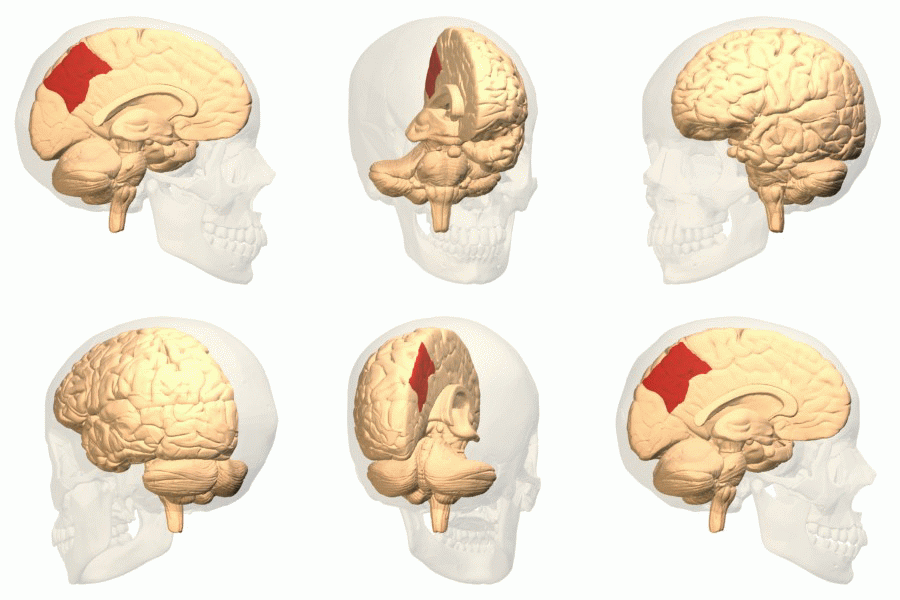
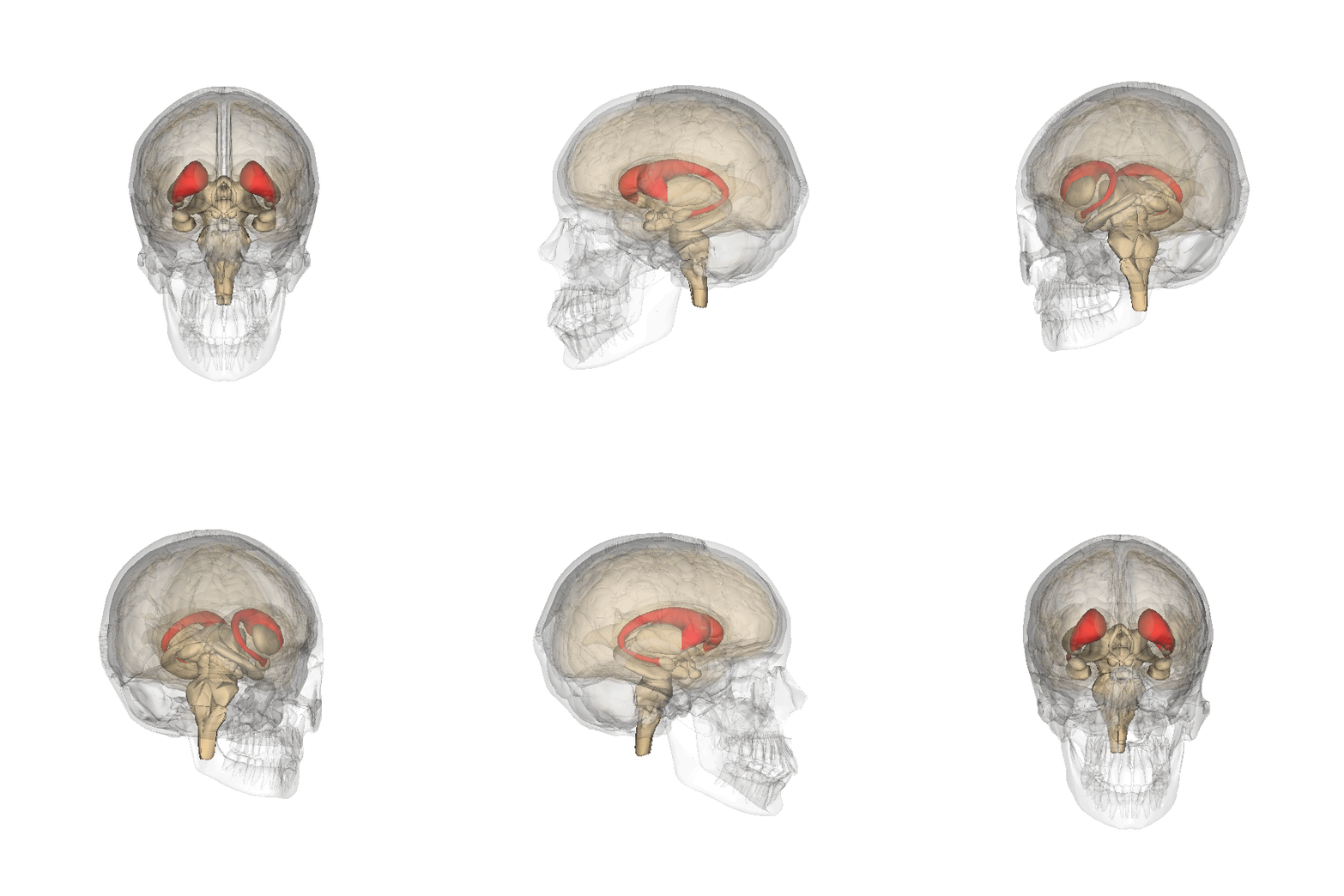
Unlike amateur players, who use the precuneus area of the parietal lobe, professionals use the caudate nucleus in the center of the brain, said Keiji Tanaka at the RIKEN Brain Science Institute's Cognitive Brain Mapping Laboratory.

"Professionals are trained extensively for a long time, over 10 years, hours every day. This extensive training (may have) shifted the activity from the cerebral cortex to the caudate nucleus," the study's lead author Tanaka said.


Precuneus - Wikipedia, the free encyclopedia

Precuneus of left cerebral hemisphere(shown in red)


Functional MRI brain scans show activation in an area of the brain known as the precuneus, as exhibited here by a professional shogi player when presented with a board game pattern.

 This fMRI scan highlights activity in the caudate nucleus of a professional shogi player.

 The pros' brains showed more activity in the precuneus region of the parietal lobe, which has been linked to pattern recognition, as well as in the head of the caudate nucleus, deep within the brain. [...]
The research team found that the precuneus-caudate connection showed up consistently when professionals were asked to come up with a rapid-fire choice of moves, but not as much for the amateurs. "These results suggest that the precuneus-caudate circuit implements the automatic, yet complicated, processes of board-pattern perception and next-move generation in board game experts," the researchers reported.

2010-06-14

Computational Model Reveals How The Brain Recognizes Objects

MIT News

How the brain recognizes objects

A new computational model sheds light on the workings of the human visual system and could help advance artificial-intelligence research, too.


Researchers at MIT’s McGovern Institute for Brain Research have developed a new mathematical model to describe how the human brain visually identifies objects. The model accurately predicts human performance on certain visual-perception tasks, which suggests that it’s a good indication of what actually happens in the brain, and it could also help improve computer object-recognition systems.

The model was designed to reflect neurological evidence that in the primate brain, object identification — deciding what an object is — and object location — deciding where it is — are handled separately. “Although what and where are processed in two separate parts of the brain, they are integrated during perception to analyze the image,” says Sharat Chikkerur, lead author on a paper appearing this week in the journal Vision Research, which describes the work. “The model that we have tries to explain how this information is integrated.”


The software's analysis of an image begins with the identification of interesting features -- rudimentary shapes common to a wide variety of images. It then creates a map that depicts which features are found in which parts of the image. But thereafter, shape information and location information are processed separately, as they are in the brain.

The software creates a list of all the interesting features in the feature map, and from that, it creates another list, of all the objects that contain those features. But it doesn't record any information about where or how frequently the features occur.

At the same time, it creates a spatial map of the image that indicates where interesting features are to be found, but not what sorts of features they are.

What and where: A Bayesian inference theory of visual attention


In the theoretical framework described in this thesis, attention is part of the inference process that solves the visual recognition problem of what is where. The theory proposes a computational role for attention and leads to a model that predicts some of its main properties at the level of psychophysics and physiology. [...]

Attention and Object recognition in Videos


Collected from: Home (sharatsc)

Sources
How the brain recognizes objects
http://web.mit.edu/newsoffice/2010/people-images-0607.html

Computational model sheds light on how the brain recognizes objects
http://www.sciencedaily.com/releases/2010/06/100608101029.htm

Home (sharatsc)
http://www.sharat.org/

YouTube - Recognizing objects in video
http://www.youtube.com/watch?v=wXqwFDJJwII&feature=player_embedded#!

A neuromoprhic approach to computer vision
http://www.slideshare.net/tserre/a-neuromoprhic-approach-to-computer-vision


Related
New model reveals how the brain identifies objects
http://mcgovern.mit.edu/newsroom/press-release-archive/319-new-model-reveals-how-brain-identifies-objects

How the brain recognizes objects
http://www.physorg.com/news195112777.html

ScienceDirect - Vision Research : What and where: A Bayesian inference theory of attention
http://www.sciencedirect.com/science?_ob=ArticleURL&_udi=B6T0W-5046M49-2&_user=10&_coverDate=05%2F20%2F2010&_alid=1366928793&_rdoc=1&_fmt=high&_orig=search&_cdi=4873&_sort=r&_docanchor=&view=c&_ct=1&_acct=C000050221&_version=1&_urlVersion=0&_userid=10&md5=68ec5e0a5f4bce2750ae0f70acb69884

Microsoft PowerPoint - Walther_NIPS07.ppt - Powered by Google Docs
http://docs.google.com/viewer?url=https%3A%2F%2Fnetfiles.uiuc.edu%2Fwalther%2Fwww%2FAttentionWorkshopNIPS07%2FWalther_NIPS2007.pdf&pli=1

Tomaso Poggio
http://mcgovern.mit.edu/principal-investigators/tomaso-poggio

Thomas Serre: Research
http://web.mit.edu/serre/www/Research.htm

Thesis Defense: Sharat Chikkerur
http://mcgovern.mit.edu/events/upcoming-events/321-thesis-defense-sharat-chikkerur