Showing posts sorted by relevance for query nanotechnology. Sort by date Show all posts

2010-03-22

Loading and Selective Release of Cargo in DNA Nanotubes


DNA Nanotechnology Breakthrough Offers Promising Applications in Medicine


ScienceDaily (Mar. 17, 2010) — A team of McGill Chemistry Department researchers led by Dr. Hanadi Sleiman has achieved a major breakthrough in the development of nanotubes -- tiny "magic bullets" that could one day deliver drugs to specific diseased cells. Sleiman explains that the research involves taking DNA out of its biological context. So rather than being used as the genetic code for life, it becomes a kind of building block for tiny nanometre-scale objects.


DNA nanotubes

DNA nanotubes can carry and release cargo on demand


DNA nanotechnology

DNA nanotechnology is a branch of nanotechnology which uses the unique molecular recognition properties of DNA and other nucleic acids to create designed, controllable structures out of DNA. This has possible applications in molecular self-assembly and in DNA computing. In this field, DNA is used as a structural material rather than as a carrier of genetic information, making it an example of bionanotechnology.


Clipped from: Hanadi Sleiman


Welcome to the Sleiman Research Group


Click here to read about our research 
(link 1, link 2, link 3 )


Our research group focuses on developing the supramolecular chemistry of DNA, to address problems in both biology and nanoscience. We use this approach to design new materials for drug delivery, diagnostic tools, antitumor therapeutics, and higher-order DNA structures for the fine organization of materials on the nanometer scale.


All aboard the DNA nanotube

Sleiman's nanotubes comprise triangular DNA 'rungs' in which the corner units are rigid organic molecules.   These triangles are connected vertically using DNA strands, thus creating a nanotube structure with evenly spaced, alternating triangular 3D capsules of two different sizes (approximately 7nm and 14nm along one edge).
When the team assembled double stranded nanotubes in the presence of different sized gold nanoparticles, the particles became trapped inside their respective sized capsules like peas in a pod. 'In effect the nanotubes act like sieves, and select the correct sizes to encapsulate,' says Sleiman.

To release the cargo, the team added specific strands of DNA that are complementary to the DNA strands that close-in the particles. This causes the nanotubes to become single stranded, thus opening up the capsules and allowing the gold nanoparticles to escape.

Sources:
  1. DNA nanotechnology breakthrough offers promising applications in medicine
  2. YouTube - DNA nanotubes
  3. DNA nanotechnology - Wikipedia, the free encyclopedia
  4. Hanadi Sleiman
  5. All aboard the DNA nanotube
Related:
  1. Loading and selective release of cargo in DNA nanotubes with longitudinal variation : Abstract : Nature Chemistry
  2. Teaching an old DNA new tricks
  3. News: DNA nanotechnology breakthrough offers promising applications in medicine
  4. DNA nanotechnology breakthrough offers promising applications in medicine
  5. Breakthrough in DNA Nanotube Research

2007-11-13

Utility Fog -- Polymorphic Smart Materials


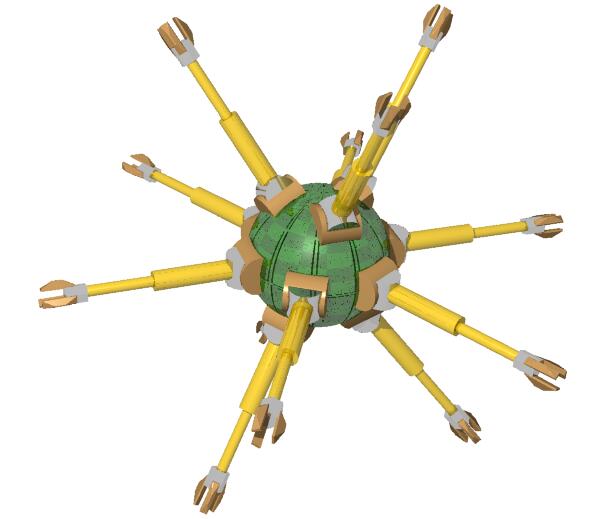
A swarm of nanobots ("Foglets") that can take the shape of virtually anything, and change shape on the fly.

Nanotechnology is based on the concept of tiny, self-replicating robots. The Utility Fog is a very simple extension of the idea: Suppose, instead of building the object you want atom by atom, the tiny robots linked their arms together to form a solid mass in the shape of the object you wanted? Then, when you got tired of that avant-garde coffeetable, the robots could simply shift around a little and you'd have an elegant Queen Anne piece instead.

Nanotechnology Now

Utility Fog


Utility Fog: (AKA: Polymorphic Smart Materials) Objects formed of "intelligent" polymorphic (able to change shape) substances, typically having an octet truss structure. Concept concieved and Graphics Copyright Dr. J. Storrs Hall. Click images for larger version.

Single Foglet
utility foglet
Foglets Holding Hands
utility foglets holding hands

Here's a short list of the powers you'd have or appear to have if embedded in fog:
  • Creation--causing objects to appear and disappear on command.
  • Levitation--causing objects to hover and fly around.
  • Manipulation--causing forces (squeezing, hitting, pulling) on objects (real ones) at a distance.
  • Teleportation--nearly any combination of telepresence and virtual reality between fog-filled locations

blog it
via: Utility Fog -The Future is Foggy! | The Daily Galaxy: News from Planet Earth & Beyond

related:
Utility fog - Wikipedia, the free encyclopedia
Utility Fog
Nanorex, Inc. - Home
LinkNotes: Search results for nanotechnology
ClipsToNote: Utility Fog -- A Swarm of Nanobots

2009-08-07

Nanoscale origami from DNA: a new toolbox for building nanoscale structures

Clipped from: Precision Nanoscale Car Parts Self-Assembled From DNA | Popular Science

Precision Nanoscale Car Parts Self-Assembled From DNA

Scientists program DNA to fold in tightly controlled curves and circles—an important step toward building larger nanomachines.


Clipped from: Nanoscale origami from DNA

Nanoscale origami from DNA

Researchers develop a new toolbox for nano-engineering

Scientists at the Technische Universitaet Muenchen (TUM) and Harvard University have thrown the lid off a new toolbox for building nanoscale structures out of DNA, with complex twisting and curving shapes. In the August 7 issue of the journal Science, they report a series of experiments in which they folded DNA, origami-like, into three dimensional objects including a beachball-shaped wireframe capsule just 50 nanometers in diameter.

"Our goal was to find out whether we could program DNA to assemble into shapes that exhibit custom curvature or twist, with features just a few nanometers wide," says biophysicist Hendrik Dietz, a professor at the Technische Universitaet Muenchen. Dietz's collaborators in these experiments were Professor William Shih and Dr. Shawn Douglas of Harvard University. "It worked," he says, "and we can now build a diversity of three-dimensional nanoscale machine parts, such as round gears or curved tubes or capsules. Assembling those parts into bigger, more complex and functional devices should be possible."

Clipped from: Origami at the Molecular Level - WSJ.com


Bioengineers learn to fold DNA into complex shapes, which researchers hope will one day revolutionize manufacturing, medicine and computing. WSJ's Robert Lee Hotz reports on how scientists are manipulating DNA's chemical rules.

The original idea of using DNA as building material appeared in a daydream. In 1980, Dr. Seeman was sipping a Bass Ale in a campus pub at the State University of New York in Albany and musing about molecular structure. For no apparent reason, as he recalls it today, he thought of a picture by Dutch artist M.C. Escher, whose work explores exotic geometry. Then into his mind there popped a way to make Escher's patterns from strands of DNA.

Today, 40 laboratories are exploring the ramifications. Even so, it could easily be decades before anyone can translate such fundamental control over DNA assembly into anything useful.


Clipped from: caDNAno - Gallery

Self-assembly of DNA into nanoscale three-dimensional shapes

Shawn M. Douglas, Hendrik Dietz, Tim Liedl, Björn Högberg, Franziska Graf, & William M. Shih
Nature. 459:414–8. 21 May 2009.


Clipped from: Welcome to the Dietz Research Group: Laboratory for Biomolecular Nanotechnology at Technische Universität München.
Home

Welcome to the Dietz Research Group at TU Munich!

What we do & How we do it.

We develop novel scientific devices and methods for applications in biomolecular physics, biological chemistry, and molecular medicine. We use DNA to build nanometer-scale devices with atomically precise features. We customize proteins and study hybrid DNA-protein complexes. 3D transmission electron microscopy, atomic force microscopy, and single molecule methods including optical trapping and fluorescence microscopy are among our routine analysis tools. Read more.


Sources:
  1. Precision Nanoscale Car Parts Self-Assembled From DNA | Popular Science
  2. Nanoscale origami from DNA
  3. Origami at the Molecular Level - WSJ.com
  4. caDNAno - Gallery
    Related:
  1. Welcome to the Dietz Research Group: Laboratory for Biomolecular Nanotechnology at Technische Universität München.
  2. DNA Nanotechnology For More Shapes and Tools
  3. Self-Assembling DNA Makes Super 3-D Nano Machines | Wired Science | Wired.com
  4. The Biodesign Institute at Arizona State University | Yan Lab
  5. Centre for DNA Nanotechnology - CDNA
  6. Nanoscale origami from DNA: Researchers develop a new toolbox for nano-engineering
  7. Rolling out DNA nanostructures in vivo
  8. Self-assembly of DNA into nanoscale three-dimensional shapes : Abstract : Nature

2010-06-24

Self-assembling Biological Nanodevices Based Upon Tensegrity

HMS website banner

Researchers create self-assembling nanodevices that move and change shape on demand

BOSTON, Mass. (June 21, 2010) —By emulating nature’s design principles, a team at Harvard’s Wyss Institute for Biologically Inspired Engineering, Harvard Medical School and Dana-Farber Cancer Institute has created nanodevices made of DNA that self-assemble and can be programmed to move and change shape on demand. In contrast to existing nanotechnologies, these programmable nanodevices are highly suitable for medical applications because DNA is both biocompatible and biodegradable.

Built at the scale of one billionth of a meter, each device is made of a circular, single-stranded DNA molecule that, once it has been mixed together with many short pieces of complementary DNA, self-assembles into a predetermined 3D structure. Double helices fold up into larger, rigid linear struts that connect by intervening single-stranded DNA. These single strands of DNA pull the struts up into a 3D form—much like tethers pull tent poles up to form a tent. The structure’s strength and stability result from the way it distributes and balances the counteracting forces of tension and compression.

This architectural principle—known as tensegrity—has been the focus of artists and architects for many years, but it also exists throughout nature. In the human body, for example, bones serve as compression struts, with muscles, tendons and ligaments acting as tension bearers that enable us to stand up against gravity. The same principle governs how cells control their shape at the microscale.

An electron micrograph of an actual nanoscale tensegrity built using the new DNA-based, self-assembling nanofabrication capabilities. Scale bars equal 20 nanometers (billionths of a meter). Images by Tim Liedl

Nature Nanotechnology
Published online: 20 June 2010 | doi:10.1038/nnano.2010.107

Self-assembly of three-dimensional prestressed tensegrity structures from DNA

Tim Liedl Björn, Högberg, Jessica Tytell, Donald E. Ingber & William M. Shih


Tensegrity


Tensegrity structures are structures based on the combination of a few simple but subtle and deep design patterns:
  • loading members only in pure compression or pure tension, meaning the structure will only fail if the cables yield or the rods buckle
  • preload or tensional prestress, which allows cables to be rigid in tension
  • mechanical stability, which allows the members to remain in tension/compression as stress on the structure increases
Because of these patterns, no structural member experiences a bending moment. This produces exceptionally rigid structures for their mass and for the cross section of the components.


Welcome to the Shih Lab. We explore design principles for self-assembling molecular machines, primarily using structural DNA nanotechnology to build our model systems. We seek to apply our knowledge towards construction of artificial systems that help solve problems of biological and medical interest.
[...]

Collected from: Home

William Shih

Shih is an Associate Professor in the Department of Biological Chemistry and Molecular Pharmacology at Harvard Medical School, and Department of Cancer Biology at the Dana-Farber Cancer Institute.
[...]


Sources
HMS Press Release - Researchers create self-assembling nanodevices that move and change shape on demand
http://hms.harvard.edu/public/news/2010/062110_ingber.html
Self-assembly of three-dimensional prestressed tensegrity structures from DNA : Abstract : Nature Nanotechnology
http://www.nature.com/nnano/journal/vaop/ncurrent/abs/nnano.2010.107.html
Tensegrity - Wikipedia, the free encyclopedia
http://en.wikipedia.org/wiki/Tensegrity
YouTube - Step by Step Tensegrities (the real thing)
http://www.youtube.com/watch?v=HPLcci1uoEI
Home : Wyss Institute at Harvard
http://wyss.harvard.edu/
Home
http://research4.dfci.harvard.edu/shih/SHIH_LAB/Home.html
William Shih : Wyss Institute at Harvard
http://wyss.harvard.edu/viewpage/127/william-shih

Related
Researchers create self-assembling nanodevices that move and change shape on demand
http://www.eurekalert.org/pub_releases/2010-06/hms-rcs062110.php
Researchers create self-assembling nanodevices that move and change shape on demand
http://www.physorg.com/news196427602.html
Researchers create self-assembling nanodevices that move and change shape on demand
http://www.sciencedaily.com/releases/2010/06/100622091740.htm
DailyTech - Harvard Debuts Self-assembling Biological Nanodevices
http://www.dailytech.com/article.aspx?newsid=18818
Creation Of Self-Assembling Nanodevices That Move And Change Shape On Demand
http://www.medicalnewstoday.com/articles/192640.php

2007-06-29

Nanotechnology - Computer Memory

A team of chemists at Brown University have devised a simple way to synthesize iron-platinum nanorods and nanowires while controlling both size and composition. Nanorods with uniform shape and magnetic alignment are one key to the next generation of high-density information storage, but have been difficult to make in bulk.
via: Computer memory may become compact with the new nanotechnology ~ Techlivez.com irresistible technology

2010-03-25

Self-assembling Computer Chips

Self-assembling computer chips

Molecules that arrange themselves into predictable patterns on silicon chips could lead to microprocessors with much smaller circuit elements.

The features on computer chips are getting so small that soon the process used to make them, which has hardly changed in the last 50 years, won’t work anymore. One of the alternatives that academic researchers have been exploring is to create tiny circuits using molecules that automatically arrange themselves into useful patterns. In a paper that appeared Monday in Nature Nanotechnology, MIT researchers have taken an important step toward making that approach practical.


MIT researchers coaxed tiny, chainlike molecules to arrange themselves into complex patterns, like this one, on a silicon chip. Previously, self-assembling molecules have required some kind of template on the chip surface — either a trench etched into the chip, or a pattern created through chemical modification. But the MIT technique instead uses sparse silicon “hitching posts.” The molecules attach themselves to the posts and spontaneously assume the desired patterns.
Image: Yeon Sik Jung and Joel Yang


Research Areas:

Prof. Ross’s group research is directed towards the following areas:
  • Fabrication of magnetic films, multilayers and small magnetic structures, with applications in magnetic logic, magnetic random access memory, hard disks, and bit-patterned media
  • Magnetooptical oxides including perovskites and other oxides for use in integrated optical components such as magnetooptical isolators
  • Self-assembly of block copolymers, with particular application to nanolithography, and in other self-assembling systems such as dewetting of thin metal films and porous alumina formation.

Clipped from: Thomas Research Group


MISSION

Our research is focused on the development of novel polymers and polymer-based composite materials with unusual optical, mechanical, and electronic properties. The research is very interdisciplinary with members having backgrounds in materials science, chemistry, physics and mechanical engineering. The main areas of current interest include photonics, phononics, mechanical properties of complex materials, and polymer structure and morphology.


Molecules could create tiny circuits on computer chips

With its minor reliance on electron-beam lithography, the new method could offer cost-effective fabrication in areas besides . For example, the technique could be used to produce stamps for creating magnetic patterns on hard disks, which are currently produced with electron-beam lithography. However, more research is required before manufacturing individual computer chips with self-assembling molecules, such as getting the molecules to form the exact patterns needed to produce functioning circuits.

More information: Joel K. W. Yang, Yeon Sik Jung, Jae-Byum Chang, R. A. Mickiewicz, A. Alexander-Katz, C. A. Ross & Karl K. Berggren. “Complex self-assembled patterns using sparse commensurate templates with locally varying motifs.” Nature Nanotechnology. Doi:10.1038/nnano.2010.30.
via: MIT News


Sources:
  1. Self-assembling computer chips
  2. Magnetic Materials and Devices Group - MIT
  3. Thomas Research Group
  4. Thomas Group Research
  5. Molecules could create tiny circuits on computer chips
Related:
  1. Building microchips from the bottom up (8/16/2008)
  2. MIT building self-assembling computer chips | Crave - CNET
  3. Microsoft Word - chuang_tsa.doc - Powered by Google Docs
  4. Molecules arrange themselves into predictable patterns
  5. Building microchips from the bottom up
  6. DMSE - Faculty - Caroline A. Ross
  7. Complex self-assembled patterns using sparse commensurate templates with locally varying motifs : Abstract : Nature Nanotechnology

2008-02-26

IBM's self-assembling nanotechnology

Self-assembly is a term used to describe processes in which systems of pre-existing components form an organized structure as a consequence of specific, local interactions among the components themselves, without external direction. IBM is developing ways to use this in the chipmaking process

Helping to keep Moore’s Law alive and well--as shown in recent news--are IBM scientist who have developed a self-assembly technique where microscopic processing structures can develop independently. New York Times author Michael Fitzgerald describes the scientists’ technique:

clipped from www.news.com


Kelly says IBM is developing a number of ways to use self-assembly in other parts of the chipmaking process.


Richard Doherty, director of the engineering consultant group Envisioneering, says self-assembly techniques should also greatly reduce the number of defective chips, helping to give fabs better returns.


The techniques could lead to more dramatic advances. Alain E. Kaloyeros, professor of nanoelectronics at SUNY Albany, says self-assembling nanotechnology will make it possible to etch a computer onto a pair of glasses, or to create "nanobots" that can float in our bloodstreams, searching for cancerous cells that the bots will then eliminate.


blog it
Related:
Reality Crowd » Blog Archive » Moore’s Law and the Future of Computing
Trying to put new zip into Moore's Law | CNET News.com
IBM Press room - Using Self Assembly to Create Airgap Microprocessors - United States
IBM Press room - 2007-05-03 IBM Brings Nature to Computer Chip Manufacturing - United States
IBM Research | Press Resources | IBM demos new nanotechnology method to build chip components
Small Times - IBM's directed self-assembly one facet in broad nanotech program

2012-08-26

Wood Pulp, World's New Wonder Material

Why wood pulp is world's new wonder material - tech - 23 August 2012 - New Scientist

Nanocrystalline cellulose (NCC), which is produced by processing wood pulp, is being hailed as the latest wonder material. Japan-based Pioneer Electronics is applying it to the next generation of flexible electronic displays. IBM is using it to create components for computers. Even the US army is getting in on the act, using it to make lightweight body armour and ballistic glass.

[...]

So why all the fuss? Well, not only is NCC transparent but it is made from a tightly packed array of needle-like crystals which have a strength-to-weight ratio that is eight times better than stainless steel. Even better, it's incredibly cheap.


Nanocellulose: A cheap, conductive, stronger-than-Kevlar wonder material made from wood pulp | ExtremeTech

What’s brown and sticky, lightweight, flexible, stronger than steel, stiffer than Kevlar, and conducts electricity? Nanocellulose. Oh, isn’t actually brown and sticky either: it’s transparent.

Nanocellulose is a new wonder material that is simply plant matter that has been carefully smashed to pieces, and then reformed into neatly-woven nanoscale crystals and fibers. You generally start with wood pulp, remove any non-cellulose impurities (such as lignin) using a homogenizer, and then gently beat the mixture to separate each of the cellulose fibers. Depending on the exact process used, these fibers then form into a thick paste (pictured above) of needle-like crystals (2nm wide, hundreds of nanometers long, below left), or a spaghetti-like structure of cellulose fibrils (below right).


Nanocellulose - Wikipedia, the free encyclopedia

Nanocellulose or microfibrillated cellulose (MFC), is a material composed of nanosized cellulose fibrils with a high aspect ratio (length to width ratio). Typical lateral dimensions are 5–20 nanometers and longitudinal dimension is in a wide range from 10s of nanometers to several microns. It is pseudo-plastic. Moreover, nanocellulose exhibits the property of certain gels or fluids that are thick (viscous) under normal conditions, but flow (become thin, less viscous) over time when shaken, agitated, or otherwise stressed. This property is known as thixotropy. When the shearing forces are removed the gel regains much of its original state. The fibrils are isolated from any cellulose containing source including wood-based fibers (pulp fibers) through high-pressure, high temperature and high velocity impact homogenization (see manufacture below). Nanocellulose can also be obtained from native fibers by an acid hydrolysis, giving rise to highly crystalline and rigid nanoparticles (generally referred to as nanowhiskers) which are shorter (100s to 1000 nanometers) than the nanofibrils obtained through the homogenization route.


Forest Products Laboratory - USDA Forest Service

Nanotechnology

A leader in wood products research for over a century, the FPL is positioning itself to become the lead Federal research facility for the application of nanotechnology in forest products. Using structural, chemical, and mechanical evaluation techniques, interdisciplinary teams of scientists continue to expand FPL's nanotechnology research program.


2007-08-29

Nanofactories (video)

Animatie over machines - zoiets als desktop printers - die werken op basis van nano-robots

A nanofactory is a proposed system in which nanomachines (resembling molecular assemblers, or industrial robot arms) would combine reactive molecules via mechanosynthesis to build larger atomically precise parts. These, in turn, would be assembled by positioning mechanisms of assorted sizes to build macroscopic (visible) but still atomically-precise products.
[Molecular assembler - Wikipedia, the free encyclopedia]
via: National Nanotechnology Initiatives - Several Countries are in the Nanotech Race

2009-10-04

Paper-Based Thin-Film Batteries

Technology Review - Published By MIT
A Salt and Paper Battery

The simple, non-polluting battery could be used in compact devices.

Researchers at Uppsala University in Sweden have made a flexible battery using two common, cheap ingredients: cellulose and salt. The lightweight, rechargeable battery uses thin pieces of paper--pressed mats of tangled cellulose fibers--for electrodes, while a salt solution acts as the electrolyte.

clipped from pubs.acs.org
Nano Letters

Ultrafast All-Polymer Paper-Based Batteries

Abstract Image

The key to the discovery lies in the way in which the algae, Cladophora, produce a unique type of cellulose with a very large surface area (approximately 80 square meters of surface area per gram of material).

Uppsala universitet

Nanotechnology and Functional Materials

Welcome to the division for Nanotechnology and Functional Materials. We are a part of the Department for Engineering sciences and situated at the Ångström Laboratory. The division was established in 2004 and is headed by prof. Maria Strømme.


blog it
Sources:
  1. Technology Review: A Salt and Paper Battery
  2. Ultrafast All-Polymer Paper-Based Batteries - Nano Letters (ACS Publications)
  3. Swedish Researchers Discover Algae-Based, Non-Metallic Batteries | Alt Dot Energy
  4. Nanotechnology and Functional Materials
Related: